

Blasphemy in a Ball Cap
Fact-checking Mark Driscoll's response to Adam Allred

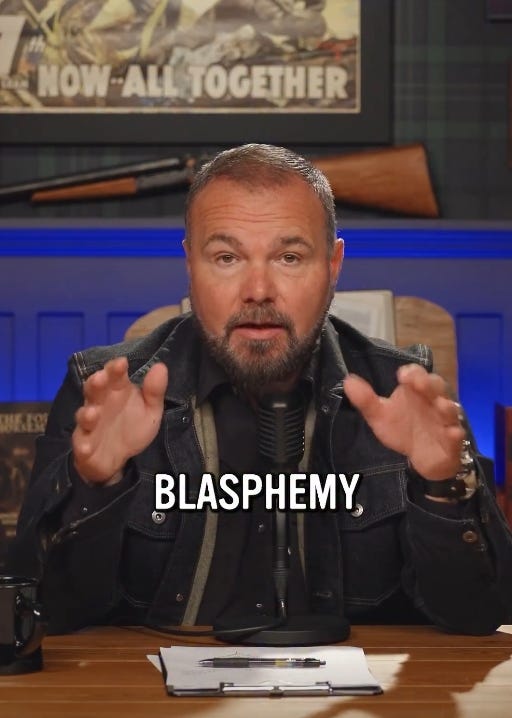
In a recent social media post, Mark Driscoll spent three minutes calling Adam Allred a liar, an apostate, and a mouthpiece for Satan. That’s a busy three minutes. He closed his rant by calling the whole thing “blasphemy in a ball cap.” Awfully strong language there, Mark, and I suspect it calls for some strong scrutiny, so let’s check the claims he made in the video response, one at a time. Almost none of them hold up when verified against the actual historical record.
This isn’t meant to be a defense of everything Allred said. Full disclosure, before this clip crossed my feed, I’d never heard of Adam Allred and had to look him up to see who he was. His line about the Bible being “voted on by a pagan emperor” is its own oversimplification, I fear. If he was gesturing at the very real impact Constantine and his successors had on the shape and institutional power of the church, however, he isn’t wrong about that. But that’s not what’s under scrutiny here. Driscoll didn’t just disagree with Allred. He made a series of specific, checkable historical claims, and got nearly all of them flat wrong. Impressive.
“Jesus wasn’t a Christian, he was a Jew.”
This is the line Driscoll opens with, calling it blasphemy twice, without ever once explaining why. He pivots straight into defending the Bible’s transmission history, as though a claim about manuscripts answers a claim about Jesus’s religious identity. It doesn’t, because Allred’s claim about Jesus’s religious identity happens to be accurate.
Jesus was circumcised on the eighth day, in keeping with Torah law.{1} He was presented at the Temple as an infant for the same reason.{2} Luke says he attended synagogue “as was his custom.”{3} He wore tzitzit, the tasseled fringes Torah-observant Jewish men wore on the corners of their garments as a reminder to keep the commandments. The woman with the twelve-year hemorrhage in Matthew 9 reaches specifically for those fringes, and the Greek word Matthew uses for them, kraspedon, is the same word the Septuagint uses for the ritual tassel commanded in Numbers.{4} He argued Torah interpretation with other Jewish teachers in the manner of a rabbi, and told a crowd directly that he came not to abolish the Law but to fulfill it.{5}
None of this is a fringe reading, pun partially intended. It’s the starting point of nearly every serious historical study of Jesus published in the last forty years, including from scholars far more theologically conservative than either Allred or me. E.P. Sanders’s Jesus and Judaism, the book that reoriented a whole generation of historical Jesus scholarship, opens from exactly this premise.{6} N.T. Wright, who has built a career defending the historicity of the resurrection against skeptics, insists that Jesus only makes sense read as a first-century Jew working within Jewish categories, not against them.{7}
The word “Christian” itself doesn’t belong anywhere near Jesus’s lifetime. It shows up exactly three times in the whole New Testament, and the first instance says plainly where it came from: outsiders in Antioch coined it to describe the movement years after the crucifixion, once it had grown to include large numbers of non-Jews.{8} Jesus never used the word. He couldn’t have. It didn’t exist yet.
“He didn’t come to create a religion” is a different kind of claim, more interpretive than a flat historical fact, since it’s about intent rather than identity. But it’s not exactly a lonely position either. A lot of serious scholarship outside evangelical apologetics leans the same direction Allred does here, from Albert Schweitzer’s century-old case that Jesus expected God’s imminent reign rather than a new institution, through E.P. Sanders and Bart Ehrman’s work on Jesus as an apocalyptic Jewish prophet.{9} “Jesus wasn’t a Christian, he was a Jew” sits in a different category entirely, a plain description rather than a debatable opinion. Driscoll calling it blasphemy without ever engaging it stands in for the argument he never actually made.
“The Old Testament Canon was closed by the days of Jesus.”
It wasn’t, and this isn’t just a random opinion. First-century Judaism had no single, agreed list of scripture. The Samaritans held, and still hold, to a canon of five books, the Torah alone, rejecting the Prophets and Writings entirely.{10} The community at Qumran kept multiple copies of books like Jubilees and 1 Enoch, treating at least the former with something close to the authority of the Torah in their own sectarian writings, with no clear line drawn between them and the books that later became scripture.{11} One of those books even made it into the New Testament by name: the epistle of Jude quotes 1 Enoch directly and calls it prophecy.{12} The Greek-speaking Jewish world, whose scriptures the New Testament authors quote from constantly, used the Septuagint, a wider collection that included books Protestants would later exclude as “Apocrypha” but that Catholics and Orthodox Christians still read as scripture today. Even the edges of the narrower Hebrew collection were still being argued over well past Jesus’s lifetime. The Mishnah records rabbis at Yavneh, a generation after the Temple’s destruction, disputing whether Ecclesiastes and Song of Songs belonged in scripture at all.{13} “Closed canon” is a real historical claim with a real, much later date. It is not something that describes first-century Judaism at all.
“The Bible was not written hundreds of years after the fact. It was written by eyewitnesses.”
This is false under the historical-critical view, and it’s even false under Driscoll’s own preferred tradition too, which is the more interesting problem for him. None of the four Gospels names its author inside the text. The titles were attached by church tradition starting in the second century, decades after the books were written.{14} That’s the working consensus across the field of New Testament studies, not some fringe theory. But set that aside entirely and just take the traditional attributions at face value. Church tradition itself, going back to the early-second-century bishop Papias, holds that “Mark” was Peter’s secretary, writing down what he remembered of Peter’s preaching. Papias’s own account is explicit on the point: Mark “neither heard the Lord nor followed him.”{15} “Luke” says outright, in the first two verses of his own Gospel, that he’s compiling the testimony of others who were eyewitnesses “from the beginning,” which is Luke’s own way of telling us he wasn’t one.{16} That’s half the Gospels ruled out as eyewitness accounts by the very tradition Driscoll is defending, before a single skeptical scholar even enters the conversation. And Paul, whose letters are the earliest documents in the New Testament, never met Jesus before the crucifixion. He says so himself.{17} Driscoll is reciting inerrantist dogma here, not offering a serious scholarly position, and that dogma collapses on contact with the very tradition he claims to defend.
“The New Testament Canon is closed” by “the end of the first century.”
This one isn’t a matter of interpretation. It’s a date, and it’s wrong by almost three hundred years. The standard reference work on this question, Bruce Metzger’s The Canon of the New Testament, identifies the first list matching our current twenty-seven books as Athanasius’s Thirty-Ninth Festal Letter, written in 367 CE, and even that was one bishop’s letter, not a churchwide ruling.{18} Formal regional endorsement came later still, at synods in Hippo in 393 and Carthage in 397.{19} In the centuries between the apostles’ deaths and that point, the early church argued openly over which books counted. Revelation and 2 Peter were disputed for generations. Meanwhile, some of our oldest surviving complete Bibles, including Codex Sinaiticus, bind in books like the Shepherd of Hermas and the Epistle of Barnabas as scripture, right alongside the books we still read today, books that later dropped out of the canon entirely.{20} None of that fits inside “the end of the first century.”
2 Timothy 3:16, “All Scripture is God-breathed.”
Read the sentence this verse is actually finishing. The verse before it says these are “the sacred writings” Timothy has known “from childhood,” a description that can only point backward to the Hebrew scriptures Timothy would have learned as a boy, long before Paul wrote him a word and long before anything resembling a New Testament existed to be known.{21} Whatever this verse is certifying, it’s certifying the scriptures a first-century Jewish child already had, not a twenty-seven-book Christian canon that wouldn’t take its final shape for another three centuries. Using it to declare the whole Protestant Bible flawless reads a claim into the verse that the verse, on its own terms, doesn’t make.
Hebrews 4:12, “the word of God is powerful and active.”
Driscoll turns this into a claim about a book. The passage itself doesn’t cooperate. Keep reading one more verse: “no creature is hidden from his sight, but all are naked and exposed to the eyes of him to whom we must give account.”{22} The word of God in verse 12 slides directly into “him” in verse 13, a person, not a text. The whole section is built on a warning quoted three times in the two preceding chapters, from Psalm 95: “Today, if you hear his voice, do not harden your hearts.”{23} This is about God’s own living address to a listener who might refuse to hear it, not an epistemological claim about the inerrancy of a bound anthology. If anything, reading “the word of God” here as a person rather than a book is the older, more serious theological position. It’s the same identification John makes at the start of his Gospel, and the same one Revelation makes when it names the rider on the white horse “the Word of God.”{24} Driscoll skipped past a Christological reading to get to a bibliological one.
None of this required special expertise to check, though most people watching that video won’t check it. It required opening the passage Driscoll himself cited and reading one verse further, or looking up a date in a reference book any seminary library carries. I don’t know Adam Allred, and I have no reason to defend everything he says. But on the specific claims at issue here, he’s the one working from the actual historical and textual record. Driscoll is the one getting the history, the textual context, and in one case the century, wrong. That leaves two options. Either he doesn’t know this material as well as his tone suggests, or he does and skipped past it anyway because it was inconvenient. I’m not sure which is worse in a man who just called someone else a false teacher and a blasphemer on camera. “Blasphemy” is a serious word. So is “lie.” Before reaching for either, Mark, it might be worth doing a little more than three minutes of real homework first.
Notes
{1} Luke 2:21.
{2} Luke 2:22-24.
{3} Luke 4:16.
{4} Matthew 9:20-22; the same Greek term, kraspedon, appears in Matthew 23:5, where Jesus criticizes Pharisees for lengthening their tassels rather than for wearing them, implying he wore his own at ordinary length. On the term and its background in Numbers 15:38-39, see the entry on tzitzit in any standard Bible dictionary.
{5} Matthew 5:17.
{6} E.P. Sanders, Jesus and Judaism (Philadelphia: Fortress Press, 1985).
{7} N.T. Wright, Jesus and the Victory of God (Minneapolis: Fortress Press, 1996), the second volume of his Christian Origins and the Question of God series.
{8} Acts 11:26; the word also appears at Acts 26:28 and 1 Peter 4:16, and nowhere else in the New Testament.
{9} Albert Schweitzer, The Quest of the Historical Jesus (1906); E.P. Sanders, Jesus and Judaism; Bart D. Ehrman, Jesus: Apocalyptic Prophet of the New Millennium (Oxford: Oxford University Press, 1999). None of these scholars frame the point as Allred does, but all three read Jesus’s own expectation as the imminent arrival of God’s reign, not the founding of a new, lasting religious institution.
{10} Ingrid Hjelm, “The Samaritan and Jewish Versions of the Pentateuch: A Survey,” Religions 11, no. 2 (2020).
{11} Fragments of at least fifteen manuscripts of Jubilees have been recovered from five different Qumran caves, and the Damascus Document cites Jubilees with an authority approaching that of the Torah. Cave 4 also yielded eleven Aramaic manuscripts of parts of 1 Enoch. See James C. VanderKam, The Dead Sea Scrolls Today, 2nd ed. (Grand Rapids: Eerdmans, 2010); “The ‘Other’ Bible from Qumran,” Bible Odyssey (Society of Biblical Literature). Scholars caution against overstating the point: no Qumran text directly states that the community considered 1 Enoch scripture in a formal sense, and the claim remains debated. What isn’t debated is that they kept and used it extensively alongside texts that later became canonical.
{12} Jude 14-15, quoting 1 Enoch 1:9 and introducing it with “Enoch, the seventh from Adam, prophesied, saying...”
{13} Mishnah Yadayim 3:5, recording the dispute over whether Ecclesiastes and Song of Songs “defile the hands,” rabbinic shorthand for canonical status. The dispute is set at Yavneh in the period after 70 CE and continues to be discussed in the Babylonian Talmud, Megillah 7a and Shabbat 30b.
{14} See Bart D. Ehrman, How Jesus Became God (New York: HarperOne, 2014), and Jesus Interrupted (New York: HarperOne, 2009), for the standard account of anonymous composition and later attribution.
{15} Papias, quoted in Eusebius, Ecclesiastical History 3.39.15: “Mark, having become the interpreter of Peter, wrote down accurately, though not indeed in order, whatsoever he remembered of the things done or said by Christ. For he neither heard the Lord nor followed him.”
{16} Luke 1:1-2.
{17} Galatians 1:11-17.
{18} Bruce M. Metzger, The Canon of the New Testament: Its Origin, Development, and Significance (Oxford: Clarendon Press, 1987).
{19} Metzger, Canon of the New Testament; the councils’ decisions ratified rather than originated the list already reflected in Athanasius’s letter.
{20} On Codex Sinaiticus and its contents, including the Epistle of Barnabas and the Shepherd of Hermas bound after the New Testament, see the manuscript description published by the Codex Sinaiticus Project (British Library, in partnership with the National Library of Russia, Leipzig University Library, and Saint Catherine’s Monastery).
{21} 2 Timothy 3:14-16.
{22} Hebrews 4:12-13.
{23} Psalm 95:7-8, quoted in Hebrews 3:7-11, 3:15, and 4:7.
{24} John 1:1; Revelation 19:13.
Mark Driscoll has been a thorn in the side of the Church for quite a long time now. The whole Mars Hill experience came to a completel halt due to his bullying & decpetive behavior....but he's still at it. You did a great job of taking hie down, but please don't waste too much time on a guy like him - he's not worth the trouble to orrect him over 7 over again.
Excellent rebuttal. I have never taken this guy seriously, but may have and (surprisingly) still do, so your work is timely and needed. Also, love the optics of him with the shotgun behind him. Nothing says "God is love" like a shotgun. 🤦♂️ And I'm a hunter, so I'm not opposed to firearms. They just have absolutely no place in my life or witness as a follower of Jesus.