

Sacred and Wrong
The Translation That Became the Tradition

There is a joke that circulates in biblical studies circles. A pastor, shown a Greek manuscript that differs from his King James Bible, declares the manuscript must be wrong. The joke lands because it perfectly inverts the actual translation process. You do not correct the Greek with the English. You correct the English with the Greek. The fact that this requires explanation, and that it is not obvious to a significant portion of American Christianity, tells you most of what you need to know about biblical literacy in evangelical culture.
KJV-Onlyism, the belief that the 1611 King James Version is the uniquely inspired, authoritative, and superior English Bible, is an extreme position. Most people who prefer the KJV do not go that far. But the assumptions underneath KJV-Onlyism bleed into broader evangelical culture in ways that matter considerably. The KJV sounds authoritative. It sounds ancient. It sounds like what the Bible is supposed to sound like. For many believers, the familiarity of its cadences functions as a kind of proof. This is what God sounds like, therefore this is precisely what God said. That conflation of aesthetic preference with textual accuracy is where the problems begin.
Dan McClellan, a scholar of the Bible and religion, puts the basic judgment plainly: the King James Version is most valuable today as a literary artifact. For understanding what the biblical authors were actually trying to communicate, it falls significantly short. There are three main reasons for that, and they compound each other.
What the KJV Translators Actually Had and What They Were Trying to Do
The King James translators were serious scholars. They consulted Hebrew manuscripts, Greek manuscripts, the Septuagint (the ancient Greek translation of the Hebrew scriptures, completed over several centuries beginning around 250 BCE), Latin versions, and earlier English translations. Their own preface openly discussed textual difficulties and the challenges of rendering ancient languages into English. They never claimed their translation was superior to the Greek and Hebrew originals. The KJV-Only position would surely have struck them as absurd, and possibly as an actual form of idolatry.
The problem is not who they were. It is what they had to work with, and what they were commissioned to produce.
N.T. Wright draws a sharp contrast between William Tyndale and King James’s team. Tyndale, who pioneered the English Bible a century earlier and whose work forms the backbone of the KJV, translated with radical intent. He wanted the Bible in the hands of ordinary people, in direct, street-level English close to the Greek. It cost him his life: he was strangled and burned at the stake in 1536 in Vilvoorde, Belgium, on charges of heresy. King James’s translators had a different mandate entirely. They were not trying to stir things up. They were trying to quiet things down. Faced with warring religious factions threatening to fracture both church and kingdom, James commissioned a unified translation as a stabilizing political instrument. The elevated, magisterial prose that later generations came to revere as sacred was, in significant part, a political choice. Its effect, as Wright notes, was to make the Bible once again a somewhat elevated book, one that was just a little above the common reader. That was not an accident.
The Greek manuscript tradition underlying the KJV is known as the Textus Receptus, compiled primarily by the Dutch scholar Erasmus in the early sixteenth century. Erasmus worked from a handful of late medieval Greek manuscripts, none earlier than the twelfth century, and in at least one instance reconstructed missing text by translating backward from the Latin Vulgate into Greek. Yes: from the original Greek, into Latin, and then back into Greek again. He was working with what was available. But what was available in 1516 bears little resemblance to the manuscript base scholars work from today.
Why Manuscripts Matter and What We Have Now
Bart Ehrman, in Misquoting Jesus, describes the scope of the problem. Scholars now have access to more than 5,700 Greek manuscripts of the New Testament, ranging from small fragments to complete codices. They do not all say the same thing. Hundreds of thousands of textual variants exist across the manuscript tradition, ranging from obvious scribal slips to theologically significant additions. Textual criticism exists to work through those variants and reconstruct, as carefully as possible, what the earliest recoverable text likely said.
The manuscripts available to Erasmus and the KJV translators were late, relatively few, and heavily shaped by the Byzantine tradition. In the centuries since 1611, earlier and more geographically diverse manuscripts have surfaced that give scholars a far richer picture of how the texts developed and were transmitted. The Codex Sinaiticus and Codex Vaticanus, both dating to the fourth century, were either unknown or inaccessible to the KJV translators. The Dead Sea Scrolls, discovered in 1947, transformed the study of the Hebrew Bible and its transmission. Papyri fragments from Egypt, including P52 (a fragment of John’s Gospel held at the John Rylands Library in Manchester and conventionally dated to the early second century), have pushed manuscript evidence for parts of the New Testament back toward its origins. In plain terms: what scholars have now is objectively better than what existed in 1611, and the gap is not small.
McClellan draws the direct implication. We can reconstruct a far more reliable New Testament than was possible in 1611. Modern translations like the NRSVue, the New Revised Standard Version Updated Edition released in 2021, draw on this vastly expanded manuscript base. There are approximately sixteen passages in the KJV that simply do not appear in the earliest manuscripts. Many modern translations omit those passages or flag them clearly. This is not a sign of a less faithful translation. It is a sign of a more honest one, which ought to matter to anyone who claims to care about what the text actually says.
Why Some Translations Are Simply Better
Translation is not a neutral act. Every translator brings assumptions, theological commitments, cultural context, and linguistic habits to the text. The question is not whether those factors are present, because they always are, but whether the underlying scholarship is sound and whether the methodology is honest.
McClellan identifies the KJV’s third major problem as its translation philosophy. It was, in his description, overly literal, frequently reproducing the form of the source language in a way that produced indecipherable English. He cites 2 Corinthians 2:5: “But if any have caused grief, he hath not grieved me but in part that I may not overcharge you all.” His verdict is blunt: utterly incomprehensible. The NRSVue renders the same passage as: “But if anyone has caused grief, he has caused it not to me, but to some extent — not to exaggerate it — to all of you.” The difference has nothing to do with liberal versus conservative translation. It is a matter of understanding Greek syntax and rendering the sense of the original in actual English.
Wright adds a related dimension. Good translation requires what he calls accuracy of flavor and feel, catching the tone, energy, and register of the original. The KJV applies uniform Jacobean grandeur to texts that do not share that register. Mark’s Gospel reads like a scruffy revolutionary tract, always in a hurry. Paul’s letters are often anxious and jerky, written under pressure. Adorning them in measured, magisterial prose misrepresents what those texts are doing even when individual word choices are technically correct.
Wright’s example from Romans 8:19-21 makes the point concrete. The KJV renders it: “For the earnest expectation of the creature waiteth for the manifestation of the sons of God.” It is technically accurate at the word level. It also communicates almost nothing. What Wright considers one of the most visionary, explosive short passages in Paul’s writings becomes something a reader would be tempted to skip. An adequate translation has to carry the force of what the author was doing, not only the form of what the author wrote.
McClellan also flags a problem Wright develops: the KJV was already considered outdated in the year it was published, because it was a conservative revision of a conservative revision going back nearly a century to Tyndale and Miles Coverdale. It arrived archaic and has only grown more so. His example from Jude 22, “have compassion, making a difference,” shows the damage clearly. The phrase “making a difference” did not acquire its modern meaning of having a positive impact until around 1900. In 1611, it meant making a distinction. The translators were saying to have compassion on those who are doubting, who are going back and forth. A reader today gets the opposite impression. Four centuries of linguistic drift, combined with a translation already trading in older register, produces genuine misreading — not slanted interpretation, but simple failure to communicate.
Case Studies in What Translation Choices Actually Cost
The Word That Wasn’t There
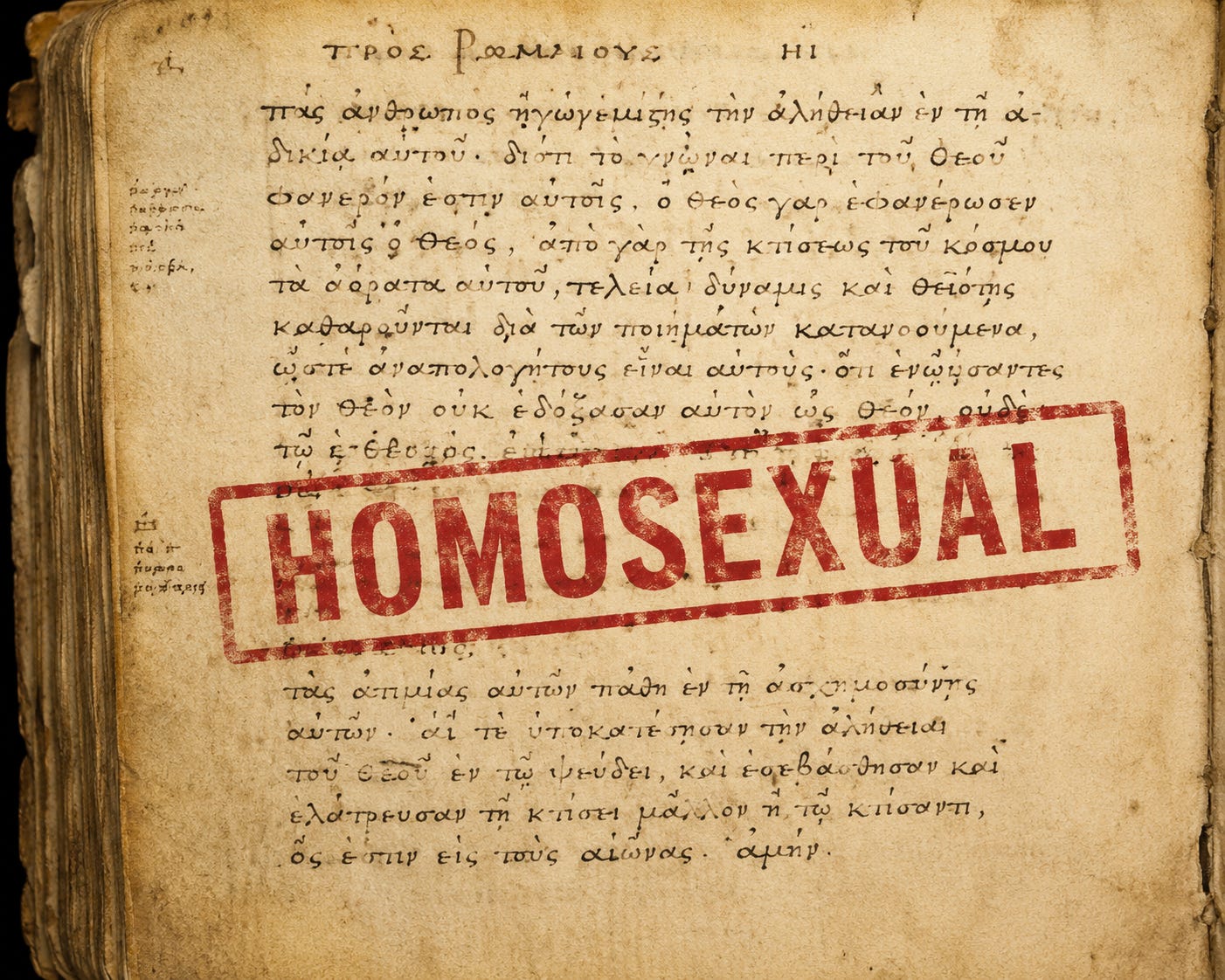
In 1946 the Revised Standard Version introduced the word “homosexual” into an English Bible for the first time. It appeared as a rendering of two Greek terms in 1 Corinthians 6:9: malakoi and arsenokoitai. The consequences reverberate through culture-war Christianity to the present day.
The KJV had rendered these terms as “effeminate” and “abusers of themselves with mankind.” Neither translation is satisfying or precise, which is itself rather instructive. The terms are genuinely difficult. Malakoi literally means “soft ones” and carried a range of meanings in ancient Greek, including moral weakness and, in some contexts, the passive partner in male same-sex acts. Arsenokoitai is a compound of the words for “male” and “bed” and appears so rarely in ancient literature that its precise meaning remains contested. Dale Martin, in his rigorous study “Arsenokoites and Malakos: Meanings and Consequences,” argues that arsenokoitai most likely referred to economic exploitation, possibly in the context of prostitution, rather than to consensual same-sex relations as a category.
What neither term does is map onto a modern concept of homosexual identity or orientation. The ancient world did not organize sexuality around identity categories the way modern Western culture does. Folding both terms into the single English word “homosexual” imports a modern concept into an ancient text and treats the result as divine prohibition. McClellan has documented that researcher Kathy Tolleson’s correspondence with the RSV translation committee revealed that Luther Weigle, the translator responsible for the rendering, later acknowledged it was intended to refer to male prostitution rather than homosexuality as a general category. The word that anchored decades of condemnation had a discoverable origin date and a contested translation history from the beginning.
The KJV’s archaic renderings, whatever their problems, at least avoided introducing a twentieth-century identity category into a first-century text. The NKJV retains “homosexuals” without qualification. The NRSVue renders these terms as “male prostitutes” and “sodomites,” which is imperfect but considerably more honest about the ambiguity involved.
A Trinitarian Verse That Wasn’t Original
In the KJV, 1 John 5:7-8 reads: “For there are three that bear record in heaven, the Father, the Word, and the Holy Ghost: and these three are one.”
This passage, known as the Comma Johanneum, is one of the most explicit Trinitarian statements in the New Testament. It is also almost certainly not original to the text.
The Comma Johanneum appears in virtually none of the early Greek manuscripts. It is absent from the Codex Sinaiticus, the Codex Vaticanus, and the overwhelming majority of the Greek manuscript tradition. It surfaces in Latin manuscripts in the fourth century and gradually works its way into later texts. Erasmus excluded it from his first two editions of the Greek New Testament on the grounds that it lacked manuscript support. He then promised to include it if a Greek manuscript containing the passage could be produced. One was produced: Codex Montfortianus, now held at Trinity College Dublin. Erasmus included the passage in his third edition while noting in his own annotations that the manuscript appeared to have been written specifically for that purpose. From Erasmus it entered the Textus Receptus, and from the Textus Receptus it entered the KJV.
Modern translations omit the Comma Johanneum or relegate it to a footnote. The KJV presents it as Scripture without qualification. Churches built explicit Trinitarian doctrine on a verse the manuscript evidence strongly suggests was added to the text centuries after John wrote his letter. That is not a minor footnote.
An interpolation, for readers unfamiliar with the term, is a passage inserted into a text by someone other than the original author. Scholars identify interpolations by examining manuscript distribution, vocabulary, style, and how passages fit the surrounding context. The Comma Johanneum fails on multiple counts.
The Snake Handlers Were Reading a Footnote
The Gospel of Mark ends, in the earliest and most reliable manuscripts, at 16:8. The women flee the empty tomb in fear and say nothing to anyone. It is an abrupt, strange, and arguably powerful ending. Early scribes apparently found it unsatisfying, and several different longer endings circulated. The version that made it into the KJV, known as the Longer Ending of Mark (16:9-20), includes material that is among the most remarkable in the New Testament: believers will cast out demons, speak in tongues, handle serpents, drink poison without harm, and heal the sick.
The textual evidence against the Longer Ending is substantial. It is absent from Codex Sinaiticus and Codex Vaticanus. Eusebius and Jerome both acknowledged in the fourth century that it was missing from most Greek manuscripts available to them. The vocabulary and style differ from the rest of Mark in ways that point to a different author. The scholarly consensus is that it is a later addition, compiled from other Gospel traditions to provide a more satisfying conclusion.
The KJV includes it without any indication of its contested status. Modern translations flag it prominently. The NRSVue places it in brackets with an explanatory heading. The practical consequences of the KJV’s uncritical inclusion are not trivial. The serpent-handling traditions of Appalachian Christianity, in which believers handle venomous snakes during worship as a demonstration of faith, built their practice directly on Mark 16:18. People have died. The theological warrant for those deaths rests on verses that almost certainly were not written by Mark, a name we attach to this Gospel by tradition rather than by any direct evidence from the text itself.
What Isaiah Actually Wrote
Matthew 1:23 quotes Isaiah 7:14 as a prophecy of the virgin birth: “Behold, a virgin shall be with child.” The KJV renders Isaiah 7:14 with the same word: “Behold, a virgin shall conceive.”
The Hebrew word in Isaiah is almah. It means young woman. It does not mean virgin. The Hebrew word for virgin is betulah, which Isaiah does not use here. The Septuagint renders almah as parthenos, which can carry the meaning of virgin, and it is the Septuagint that Matthew quotes. The translation decision happened first in the Greek, not in the Hebrew.
Isaiah was writing in the eighth century BCE about a sign relevant to his own political moment, the Syro-Ephraimite crisis. The immediate context concerns an imminent historical event. Matthew, writing in Greek and drawing on the Septuagint, finds in the passage a deeper resonance with the story of Jesus and reads it accordingly. That is a legitimate form of inner-biblical interpretation with deep roots in Jewish hermeneutic practice. What it is not is a straightforward biological prediction encoded in the Hebrew text.
The NRSVue renders Isaiah 7:14 as “young woman,” which is what the Hebrew says. The KJV renders it “virgin,” following the Septuagint’s theological reading rather than the Hebrew original. John Barton’s work on the relationship between the Hebrew Bible and its later interpreters is useful here. The Old Testament was read, translated, and reread through successive interpretive lenses, each of which left marks on the tradition. Treating the KJV’s rendering as though it transparently delivers the Hebrew text collapses that complex history into a false simplicity and then mistakes the result for Scripture’s plain and obvious meaning.
The Stakes
These are not merely academic questions, though they are that too. Translation choices shape doctrine. Doctrine shapes policy. Policy shapes lives.
The word “homosexual” inserted into 1 Corinthians in 1946 became the textual anchor for decades of condemnation, exclusion, and harm directed at LGBTQ people, many of them inside churches that had no idea the word had a discoverable origin date and a contested translation history. The Longer Ending of Mark, printed without qualification in millions of KJV Bibles, gave theological cover to practices that have killed people. The rendering of almah as “virgin” has been used to insist on a biological doctrine the Hebrew text does not require.
Wright identifies the mistake underlying all of this: the assumption that one’s own language tells it like it is, that the words we use are the natural names for things, and that other languages are simply code for one’s own. Applied to Bible translation, this produces the conviction that the KJV is the Bible, rather than a translation of the Bible made at a particular historical moment with particular tools, particular commitments, and particular limitations.
Diana Butler Bass has written about how the authority structures of American Christianity depend heavily on the illusion of a stable, unified, self-interpreting text. The KJV has served that illusion better than any other English Bible, because its archaic language functions as a sacred register, distant enough from ordinary speech to feel timeless, familiar enough from generations of repetition to feel obvious. That combination is rhetorically powerful and historically misleading.
The KJV is a monument of English literature. Its influence on the language itself, on poetry, rhetoric, and the cadences that surface in Lincoln and Toni Morrison and a hundred other places, is real and worth honoring. As a translation for serious engagement with what the biblical texts actually say, in their original languages, in their historical contexts, drawing on the best available manuscript evidence, it has been surpassed. Significantly.
Telling people otherwise, in the name of defending God’s word, is its own kind of unfaithfulness to the text. The KJV translators themselves knew that. It is past time their most devoted admirers caught up.
Endnotes
Dan McClellan, video transcript, “If You’re Looking for a Translation of the Bible That Will Help You Understand What the Biblical Authors Were Trying to Communicate, Then the King James Version Is Not for You” (social media, 2024/2025). McClellan identifies three main reasons the KJV falls short: outdated language, inferior manuscripts, and an inadequate translation philosophy.
Bart D. Ehrman, Misquoting Jesus: The Story Behind Who Changed the Bible and Why (New York: HarperOne, 2005), on the manuscript tradition, textual variants, and the history of the New Testament text.
N.T. Wright, “The Monarchs and the Message: Reflections on Bible Translation from the Sixteenth to the Twenty-First Century,” paper delivered at the International SBL Meeting, London, July 2011 (published at ntwrightpage.com, 2016). On Tyndale versus the KJV translators’ political contexts and the elevated register of the KJV as a deliberate stabilizing choice.
Dale B. Martin, “Arsenokoites and Malakos: Meanings and Consequences,” in Biblical Ethics and Homosexuality, ed. Robert L. Brawley (Louisville: Westminster John Knox, 1996), 117-136.
John Barton, A History of the Bible: The Story of the World’s Most Influential Book (New York: Viking, 2019), on canon formation, translation history, and the relationship between the Hebrew Bible and its interpreters.
On the Comma Johanneum, including the Codex Montfortianus episode, see Bruce M. Metzger, A Textual Commentary on the Greek New Testament, 2nd ed. (Stuttgart: Deutsche Bibelgesellschaft, 1994), 647-649.
On the Longer Ending of Mark, see Ehrman, Misquoting Jesus, 65-68; and Metzger, Textual Commentary, 102-107.
On almah and Isaiah 7:14, see John J. Collins, Introduction to the Hebrew Bible, 3rd ed. (Minneapolis: Fortress Press, 2018), and the textual notes in the NRSVue Study Bible.
Diana Butler Bass, Christianity After Religion: The End of Church and the Birth of a New Spiritual Awakening (New York: HarperOne, 2012), on authority structures and biblical interpretation in American Christianity.
On P52 (Papyrus 52) as the earliest known New Testament manuscript fragment, see C.H. Roberts, An Unpublished Fragment of the Fourth Gospel in the John Rylands Library (Manchester: Manchester University Press, 1935). For current dating discussions, see Brent Nongbri, God’s Library: The Archaeology of the Earliest Christian Manuscripts (New Haven: Yale University Press, 2018).
C.S. Lewis said that "there is no such thing as translating a book into another language once and for all, for language is a changing thing." He also noted the problems with the KJV clarity for the modern reader, and noted that its very beauty, solemnity, and magisterial qualities are a distraction. "Beauty exalts, but beauty also lulls." He says we may "sigh with tranquil veneration when we ought to be burning with shame or struck dumb with terror or carried out of ourselves by ravishing hopes and adorations.".
He especially recommended modern translations for those reading the Bible for the 1st time.
You are in good company.
Enough of all this, what I really want to know is the number of angels that can dance on the head of a pin.