

Straining Forward
The Cappadocian theologians and the wider Christianity they represent

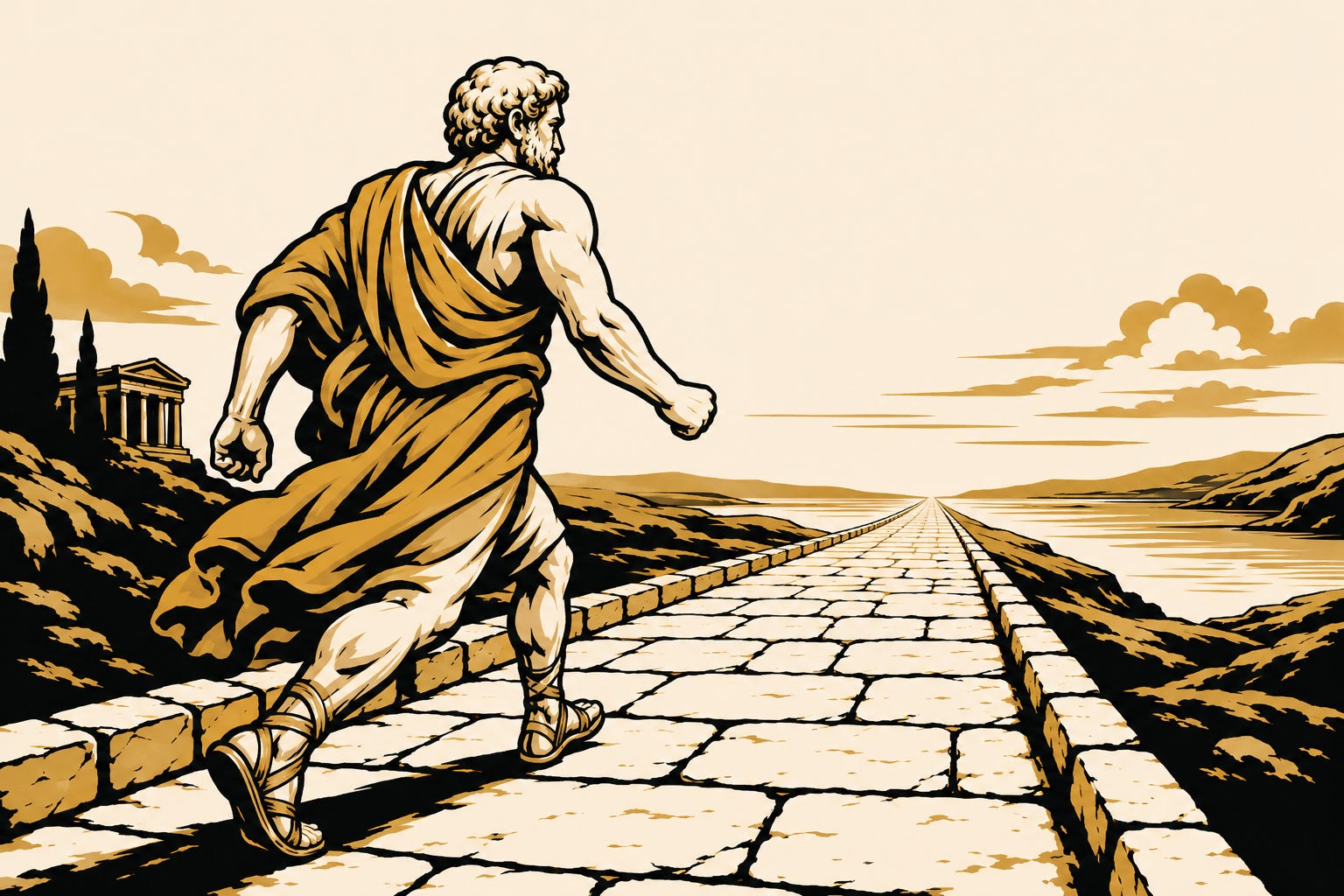
A few months ago, in a different essay, I wrote that the Cappadocian fathers occupied theological territory the Reformed tradition’s certainty culture has no patience for. Gregory of Nyssa described the soul’s movement toward God as epektasis, a perpetual straining forward in which arriving is not the point because the divine is inexhaustible. The blessed life is not a destination reached but a direction sustained.
That line pointed toward something that needed a fuller essay. So here it is.
The figures in question are known collectively as the Cappadocian Fathers: Basil of Caesarea, Gregory of Nazianzus, and Gregory of Nyssa. They lived and wrote in the fourth century in the region of Cappadocia in what is now central Turkey. Most readers who encounter their names at all encounter them only briefly — a footnote in a church history survey, a name attached to a creed, a passing reference in a course most people never took or never remember. That is a significant loss, and this essay is an attempt to set that aright.
There is also a fourth figure in this story who ought to be included in any honest account of the Cappadocian legacy. She comes later.
The world they inhabited
Christianity in the fourth century was in the middle of a crisis that makes most contemporary evangelical controversies look tame. The question on the table was not whether the church should accommodate culture. The question was whether Jesus Christ was God.
The Council of Nicaea, convened by the Emperor Constantine in 325 CE, produced a settlement. Christ was declared to be of the same substance as the Father, fully divine and not a created being. But a council’s decree and a genuine theological consensus are different things, and the controversy that preceded Nicaea did not simply end when the bishops went home.
The Arian position, named for the Alexandrian priest Arius whose teaching sparked the conflict, held that Christ was the highest of all created beings, exalted above everything else in existence, but still created by God rather than co-eternal with God. “There was a time when he was not,” in Arius’s summary. Nicaea rejected this. Arianism remained influential for decades despite the rejection, at times commanding the support of emperors and majorities of bishops.
The Cappadocians were the theologians who gave the church the conceptual vocabulary to actually articulate what Nicaea had declared. They were not armchair academics. Basil was bishop of Caesarea, one of the most significant sees in the Eastern church, and his legacy extends well beyond theology into practice: he founded what is widely recognized as one of the first hospitals in the ancient world, the Basileiad, and his homilies on wealth and poverty remain among the most challenging social documents in the patristic tradition. Gregory of Nazianzus served as bishop of Constantinople, the imperial capital. Gregory of Nyssa was Basil’s younger brother, slower to enter church work but ultimately the most philosophically penetrating of the three.
All of them were educated in classical Greek philosophy. Basil and Gregory of Nazianzus studied together at Athens. Their comfort with mystery and apophatic reasoning was not anti-intellectual. It was the product of people who knew the philosophical tradition well enough to recognize its limits.
The theology they built
Three aspects of the Cappadocian theological contribution remain relevant for anyone navigating faith seriously.
The first is apophatic theology. The term comes from the Greek apophasis, meaning negation or denial. Apophatic theology insists that God exceeds every positive description we can offer. We can say what God is not more reliably than we can say what God is, because the divine nature surpasses every category available to finite minds. This is not a form of agnosticism. It is intellectual honesty about the limits of human language when applied to the divine. Gregory of Nazianzus argued that even the concept of existence, when applied to God, is used analogically rather than literally. The God who is the ground of all being is not simply a very large version of the kind of being we encounter in ordinary experience.{1}
The Hebrew tradition anticipated this. Isaiah records the divine voice speaking directly to the limits of human comprehension: “For my thoughts are not your thoughts, nor are your ways my ways, says the Lord. For as the heavens are higher than the earth, so are my ways higher than your ways and my thoughts than your thoughts.” (Isaiah 55:8-9, NRSVue){2} The Cappadocians gave this intuition a rigorous philosophical vocabulary. That vocabulary provides contemporary readers with theological language for mystery that does not require abandoning serious engagement with the tradition. Their conclusion — that confident, comprehensive claims about the inner nature of God are epistemically problematic — sits closer to true intellectual integrity than the evangelical certainty culture that claims to preserve their legacy, knowingly or otherwise.
The second is perichoresis. This Greek term, developed by the Cappadocians and elaborated by later theologians, describes the mutual indwelling of the three persons of the Trinity, Father, Son, and Holy Spirit in a dynamic and interpenetrating relationship of love and communion. The Trinity, in this reading, is not primarily a philosophical puzzle about substance and persons. It is a relational reality, a community of love that is the ground of all created relationship.
Jesus’s prayer in John 17 is the clearest biblical anchor for this concept: “As you, Father, are in me and I am in you, may they also be in us, so that the world may believe that you have sent me.” (John 17:21, NRSVue){3} The Cappadocians took that mutual indwelling with full theological seriousness. This is the historical root of what contemporary theologians call relational trinitarianism, the argument that being itself is fundamentally relational, that the divine life is not solitary sovereignty but mutual self-giving, and that human community and love are reflections of that divine reality rather than accidents of circumstance. Jürgen Moltmann built much of his twentieth-century theological work on this Cappadocian foundation.{4} Perichoresis is not a modern import. It is fourth-century orthodoxy that much of American evangelicalism has simply failed to recognize or teach.
The third is epektasis. Gregory of Nyssa, in his Life of Moses and other mystical writings, developed this concept from a phrase in Paul’s letter to the Philippians, “straining forward to what lies ahead,” (Philippians 3:13, NRSVue){5} into a full theological account of the soul’s relationship with God. The divine, Gregory argues, is infinite and inexhaustible. The soul moving toward God never arrives at a final destination because there is no ceiling on what God is. Spiritual growth is therefore not a process of accumulation that eventually terminates in completeness. It is a perpetual movement of desire and discovery, always finding more than it has yet found, always drawn further into what cannot be exhausted.
The blessed life is not a destination reached but a direction sustained.
For people who have been told that mature faith means settled certainty, the more the better, that doubt is a problem to be fixed and mystery is a gap to be filled with better doctrine, epektasis is a genuinely liberating theological account of spiritual life. It is not a contemporary therapeutic invention. It is fourth-century Christian orthodoxy.
Macrina
Any honest account of the Cappadocian legacy includes a fourth figure: Macrina the Younger, born around 327 CE, the oldest child in the family that produced Basil and Gregory of Nyssa.
Macrina was educated in Scripture and classical literature from childhood, her mother using the Psalms and the Wisdom literature as the primary curriculum. When her fiancé died before their wedding, she chose not to remarry, devoting herself instead to an ascetic life of study, prayer, and communal living on the family estate in Pontus. She drew her mother and eventually other women into this community — one of the earliest examples of organized women’s monasticism in the Christian tradition. By every account preserved in the historical record, she was the primary theological formation of her younger brothers.
Gregory of Nyssa knew this. He wrote her biography, the Life of Macrina, in which he describes her explicitly as “the teacher” and credits her with guiding the family toward serious Christian commitment.{6} When Basil died in 379 CE, it was Macrina who consoled Gregory and redirected his grief toward theological reflection. She died shortly after, and Gregory was present for her final days, recording the scene with the care of someone who understood he was losing his primary theological interlocutor.
He also wrote On the Soul and Resurrection, a philosophical dialogue on death, the soul, and what lies beyond it, and he cast Macrina as the primary voice. The parallel to Platonic dialogue is deliberate, the teacher’s wisdom preserved through the student’s written account. Macrina is the Socrates figure in this text. Gregory is the student recording what she taught.
What she taught in that dialogue is significant beyond its literary form. The argument for the ultimate restoration of all things to God, the position we now call Gregory of Nyssa’s universalism, is put directly in Macrina’s mouth in On the Soul and Resurrection. She is the one who articulates it. Gregory is the one who records it and builds on it. The theological position most closely identified with Gregory’s legacy was, in his own account, first argued by his sister.
That she does not appear in the standard designation “Cappadocian Fathers” is a historical distortion, not a neutral description. The theology associated with the Cappadocian tradition was, in significant part, formed by a woman whose name most Christians have never heard. Her absence from the account is not accidental. It reflects a pattern that has operated throughout the history of the church, women’s theological authority filtered through male structures, credited to male names, eventually reduced to a footnote or forgotten entirely.
In a publication that recently featured an essay on precisely this dynamic in contemporary evangelical culture, the historical parallel is too direct to pass over. The pattern Erin described in her essay did not begin in the twentieth century. Macrina is evidence of how old it is.
She deserves considerably fuller treatment than this overview can provide. The A Deeper Well series will return to her soon.
The wider hope
One of the most significant and least discussed aspects of the Cappadocian legacy is Gregory of Nyssa’s position on what happens after death, specifically on whether the consequences of judgment are permanent.
The dominant position in American evangelical Christianity is what is known as eternal conscious torment, ECT for short: the damned suffer forever, without end. This position is often presented as the only biblical and orthodox option, the view serious Christians hold while sentimentalists and progressives seek softer alternatives.
Gregory of Nyssa held a different view. He believed in what Greek theology calls apokatastasis, universal restoration, the ultimate reconciliation of all things to God. Gregory’s version involved serious purification rather than a cheap, consequence-free amnesty, a process he described as demanding and painful. But he believed that the divine love, being infinite, would ultimately prove irresistible to every created thing. Nothing made by God would be permanently lost to God.{7}
The Pauline letters contain passages that have long supported this reading. Writing to the Corinthians about the final state of all things, Paul describes a moment when “the Son himself will also be subjected to the one who put all things in subjection under him, so that God may be all in all.” (1 Corinthians 15:28, NRSVue){8} The phrase “all in all” — panta en pasin in Greek — has a comprehensiveness that sits uncomfortably with a notion of eternal exclusion. Gregory read it that way. So have many serious theologians since.
This position was not unique to Gregory. Origen of Alexandria held a similar view in the third century and was condemned posthumously at the Second Council of Constantinople in 553 CE. Gregory was not condemned. His universalism coexisted with his theological authority for centuries. He is venerated as a saint in both Eastern and Western Christianity. The Second Ecumenical Council, held in Constantinople in 381 CE, whose creedal conclusions most Christians still recite, was presided over by Gregory of Nazianzus and shaped significantly by all three Cappadocians.
Gregory may or may not have been right. But the confident evangelical claim that eternal conscious torment is the only orthodox position, and that universalist alternatives represent a departure from serious Christianity, is historically false. One of the architects of the Nicene Creed was a universalist. That is not a progressive talking point. It is a fact about the tradition.
This is territory I have examined more fully in a previous essay, The Hell We Think We Know, which traces the biblical and historical evidence for and against eternal conscious torment in greater depth. The Cappadocian witness is part of that larger picture.
What any of this has to do with now
A clarification before closing, because it is relevant to everything above.
I am not advocating a return to fourth-century Nicene orthodoxy as a substitute for the evangelical certainty culture many readers are questioning or leaving behind. That would be trading one settled system for another, which is not the point. The Cappadocians held positions I find intellectually compelling, the apophatic tradition, the relational architecture of perichoresis, the epektasis account of ongoing seeking, and positions I remain genuinely unsettled on, including the metaphysical claims about Christ’s nature and the bodily resurrection. I am presenting them as historical witnesses to the tradition’s actual width, not as a new theological home.
The narrower argument is this. Evangelical Christianity has long presented itself as the guardian of ancient orthodoxy against modern compromise. The Cappadocians complicate that story at several points. Their comfort with divine mystery exceeds anything in the typical evangelical theological curriculum. Their relational understanding of the Trinity predates and arguably surpasses the functional unitarianism of much evangelical piety, which prays almost exclusively to Jesus while paying verbal tribute to the Trinity. Their most penetrating thinker held a universalist position on final judgment, and the argument for it was first made by his sister. Their theological tradition was shaped in part by a woman whose name has been systematically removed from the story.
If the tradition is the argument, the tradition is significantly more complicated than the argument acknowledges.
For people navigating post-evangelical faith, the Cappadocians offer something specific: evidence that serious, intellectually honest engagement with the Christian tradition does not require the certainty culture that made the tradition feel untenable. Epektasis is not a satisfying metaphor for people who have given up on faith. It is a fourth-century theological account of what the life of faith actually looks like when taken seriously, perpetual movement toward an inexhaustible God, never arriving, always finding more than it has yet found.
That is considerably more honest about what serious faith has always involved than anything being sold under the banner of settled dogmatism.
The next piece in this series goes deeper on Gregory of Nyssa, the most philosophically rich of the three and the figure whose work speaks most directly to the questions Drink Wisely tends to raise. The epektasis concept, the universal hope, and the theology of divine infinity all get fuller treatment there.
Endnotes
{1} On Gregory of Nazianzus and apophatic theology, see particularly his Five Theological Orations, Oration 28 (”On Theology”). For accessible secondary treatment, see Andrew Louth, The Origins of the Christian Mystical Tradition: From Plato to Denys (Oxford: Clarendon Press, 1981), 75–97; and John McGuckin, Saint Gregory of Nazianzus: An Intellectual Biography (Crestwood, NY: St. Vladimir’s Seminary Press, 2001).
{2} Isaiah 55:8-9 (NRSVue).
{3} John 17:21 (NRSVue).
{4} On perichoresis and relational trinitarianism in the Cappadocian tradition, see Jürgen Moltmann, The Trinity and the Kingdom: The Doctrine of God, trans. Margaret Kohl (San Francisco: Harper & Row, 1981), 157–176; and John Zizioulas, Being as Communion: Studies in Personhood and the Church (Crestwood, NY: St. Vladimir’s Seminary Press, 1985).
{5} Philippians 3:13 (NRSVue).
{6} Gregory of Nyssa, Life of Macrina, trans. Kevin Corrigan (Eugene, OR: Wipf & Stock, 2001). On Macrina’s significance as a theological figure in her own right, and her role in Gregory’s theological formation, see Anna M. Silvas, Macrina the Younger: Philosopher of God (Turnhout: Brepols, 2008); and Verna E. F. Harrison, God’s Many-Splendored Image: Theological Anthropology for Christian Formation (Grand Rapids: Baker Academic, 2010), which addresses Gregory of Nyssa’s theology in dialogue with Macrina’s influence.
{7} On Gregory of Nyssa’s apokatastasis, see Ilaria Ramelli, A Larger Hope? Universal Salvation from Christian Beginnings to Julian of Norwich (Eugene, OR: Cascade Books, 2019), 73–112. For the most rigorous recent philosophical and theological argument for Christian universalism, drawing extensively on Gregory of Nyssa, see David Bentley Hart, That All Shall Be Saved: Heaven, Hell, and Universal Salvation (New Haven: Yale University Press, 2019). For accessible treatment of the broader debate, see Robin Parry and Christopher Partridge, eds., Universal Salvation? The Current Debate (Grand Rapids: Eerdmans, 2003).
{8} 1 Corinthians 15:28 (NRSVue).
Thank you for putting into words what has been my sense about my walk with God/ Christ/ the Holy Spirit. And the humility it brings to my walk with my fellow humans.
If I wanted to dive deeper into this Cappadocian tradition, which places would you recommend for a good point of departure? And thank you for
writing. I always find it interesting and thought provoking.