

The Man Outside the Gate
Bart Ehrman, Matthew 25, and the untethered label

The word “Christian” has a bit of a referent problem. It once referred to something recognizable, a pattern of belief, a shape of practice, a community with at least nominal accountability to both. People argued about the edges of it constantly, because the edges were always contested. What proved harder to argue was whether the word meant anything at all. It did.
In contemporary American usage, “Christian” can describe someone who runs a food pantry and it can also describe someone who votes to defund one, and the culture contains no real mechanism that finds this contradiction structurally significant. The label has become less a descriptor of practice, then, and more a marker of tribal location. Once you start to see it in that way, some interesting problems follow.
Bart Ehrman is not a Christian. He has said so clearly, consistently, and with a precision that leaves little room for interpretive nuance. He left the faith because the problem of evil became irresolvable for him. His 2008 book God’s Problem is where he accounts for it, and it’s more genuine than most books in the genre because it doesn’t treat the departure as liberation or awakening. He simply could not reconcile an all-powerful, all-loving God with the scope of human suffering, and he stopped pretending he could.1 Agree or not; it’s honest.
Evangelical communities have a word for what Ehrman did too, and the word is apostasy. The charge carries real moral weight in those communities, and it assumes the departure was a failure of will or faith. What Ehrman documents in God’s Problem is something more specific: a man for whom theodicy became irresolvable, who followed that conclusion rather than finding a way to live around it. Whether the word fits probably depends on what you think intellectual honesty requires of a person.
He also runs one of the more consequential charitable operations in the field of popular biblical scholarship.
Ehrman maintains a subscription blog on early Christianity, and all membership fees go directly to the Bart Ehrman Foundation, which distributes them to five organizations: the Urban Ministries of Durham, the Food Bank of Central and Eastern North Carolina, the Durham Literacy Center, CARE International, and Doctors Without Borders. No overhead is taken from any of it, and his own biography describes the blog as having raised millions for organizations addressing poverty, homelessness, and hunger. Ehrman puts it plainly. “Every penny goes to help those in need.”2 The recipients are the hungry, the homeless, the illiterate, and the sick across ninety countries. This is publicly documented, verifiable, and has been running since 2012.
The man directing these proceeds to organizations like Doctors Without Borders holds, by formal credential and self-identification, no religious affiliation whatsoever.
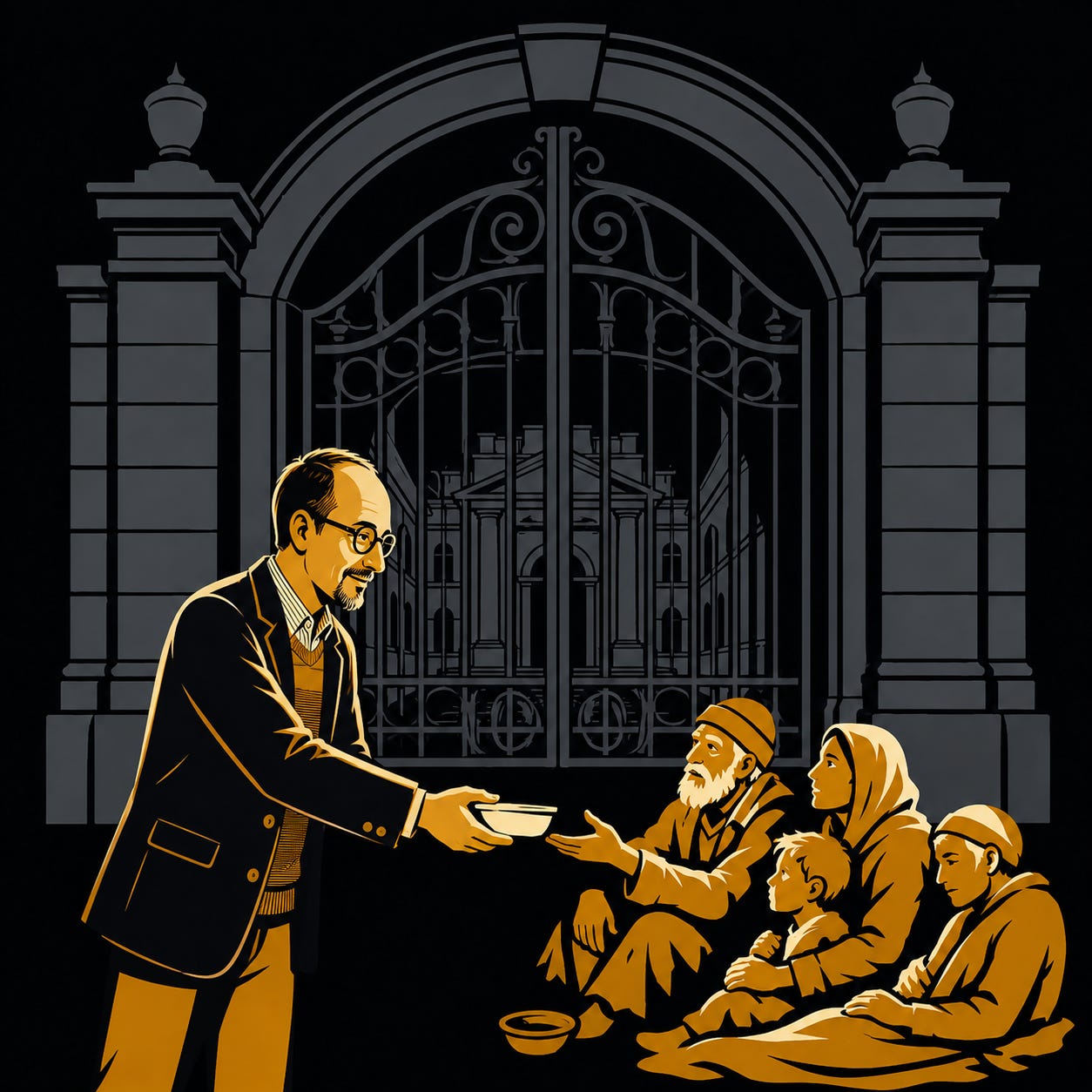
Now to Matthew 25. The text is Matthew 25:31–46, and it is the most explicit statement in the canonical Gospels about what the final judgment actually turns on. The criterion is behavioral, not propositional: feeding the hungry, giving water to the thirsty, welcoming the stranger, clothing the naked, caring for the sick, visiting the imprisoned. Confessional status is conspicuously absent from the list. The sheep didn’t know they had served Christ, the goats didn’t know they had failed him, and the whole arrangement is indifferent to identity by design.
If this text is taken seriously as a theological statement about what judgment turns on, the implications for how the label “Christian” gets assigned are fairly radical. Ehrman’s record clears the Matthew 25 bar. By public documentation, he has spent the post-faith portion of his career systematically directing resources toward the hungry, the homeless, the sick, and people who cannot read. Whatever you call that, the conduct is not in question.
Sociologist Phil Zuckerman has documented that this is a structural pattern rather than a series of exceptional cases, showing that secular people demonstrate higher consistency with neighbor-love ethics than religiously identified Americans on several specific measures, among them charitable giving, treatment of the poor, and opposition to punitive social policies.3 Ehrman is the named, culturally visible instance of that pattern.
William James made the pragmatist version of this argument in The Varieties of Religious Experience. His claim was that religious states should be judged by what they produce in conduct, not by their metaphysical pedigree. The question for James was not whether a spiritual state could pass some formal theological credential check. The question was what it made a person do.4 Whatever category you assign to Ehrman’s post-faith commitments, those commitments produce behavior that Matthew 25 would recognize without a doctrinal exam.
Tolstoy made essentially the same assertion in the 1880s, which means the institutional response is also on the record. He concluded that the ethical content of the Sermon on the Mount was indeed the core of the faith, that the institutional church had buried it under doctrine and ceremony, and that the ethics didn’t require the metaphysics to remain viable. He wrote two books arguing this at length, and the Russian Orthodox Church excommunicated him for it in 1901. He was the most famous living novelist in the world, and they threw him out anyway, which tells you something about what the institution was protecting and what it wasn’t.5
The intellectual honesty thread and the Matthew 25 thread are really the same story told from two directions. The rigor that made Ehrman follow the problem of evil out of the faith, rather than finding a theologically safe accommodation or rationale, is the same rigor that makes him take the neighbor-love command seriously when he encounters it in the texts. He didn’t stop believing in God and then decide the hungry could wait. He left one set of commitments because they became intellectually untenable and kept the ones that remained. That continuity is what makes him an impressive test case.
N.T. Wright offers the most rigorous version of this objection, and it demands a genuine response. He is arguing from the same standard of exegetical seriousness that built the case, and his concern is about the integrity of texts and the interpretive damage done when you lift their content out of the context that gives it meaning. For Wright, Matthew 25 is embedded in an apocalyptic framework, and pulling the ethical criterion out of that framework produces a domesticated reading. Kingdom ethics belong to a specific story about Israel, exile, return, and new creation, and the acts described in Matthew 25 carry their particular weight because of that story. Strip the resurrection and you’ve changed what the act means, even if the act looks identical from outside.
The sheep in Matthew 25 don’t operate within Wright’s apocalyptic framework either. They don’t know what they’ve done, why it carries eschatological significance, or that they’ve done it to Christ at all. If the text itself doesn’t require the actors to understand the framework their acts are encompassed by, it’s hard to see why the argument does. The criterion applies to people who don’t know it applies to them, which is precisely the entire point.
None of this makes Ehrman a Christian by any definition he would accept, of course, and this essay has no interest in assigning credentials he hasn’t asked for. What it suggests is that the label, if it tracks anything theologically real rather than a mere social location, has some accounting to do. The distribution of “Christian” in contemporary American life does not obviously map onto the criterion Matthew 25 applies. It’s a blunt observation, and the tradition has mostly preferred not to look at it directly.
A disclosure seems appropriate at this point. Ehrman’s work has been among the more significant influences on my own deconstruction, and I mean that in the most specific way possible. I came to him the way a lot of post-evangelical readers do, looking for historical grounding and staying for the education.
I am not an atheist. I believe in God. I believe in Jesus as a historical figure whose ethical vision remains the most morally serious thing the Western tradition has produced, whatever you make of the metaphysical claims around him. The institutional church, particularly in its modern American Protestant form, seems to me largely unable to reckon honestly with either.
What I didn’t expect was to listen to a lecture on the historical Jesus and feel something I hadn’t felt in a church in years. Not inspiration exactly, and not nostalgia. The closest description I have is the feeling of a sermon landing, the particular quality of attention that happens when something true arrives with enough force that you notice it in your chest before you process it in your head. Ehrman was talking about first-century Palestine, Roman occupation, and the social conditions that made Jesus’s message as radical as it was. He wasn’t preaching. He wasn’t trying to build my faith. He probably would find it faintly absurd that he did. But something in the rigorous historical account of who Jesus actually was and what he was actually doing made the figure more vivid, more demanding, and more compelling than forty years of sermons had managed to do.
I spent decades inside the institution, including years leading churches, and what Ehrman’s historical work gave me was a clearer picture of Jesus than any of that produced. The faith I carry now is more solid and less managed than what I embraced for better than forty years inside the walls. Ehrman didn’t build it, but he really helped clear the ground.
Ehrman has made this kind of argument himself, at book length, in his most recent work. Love Thy Stranger, published in 2026, traces how Jesus’s radical commandment to love strangers embedded itself so deeply in Western moral conscience that people act on it without knowing where it came from or what it originally required.6 A professional agnostic writing a book about the enduring ethical power of Jesus’s teaching is, by any measure, a pretty notable thing. Coming from someone the institution would not credential, about a commandment the institution has mostly failed to honor, it is a harder observation than it probably sounds.
Jesus’s ethic has a way of breaking through the borders drawn for it, turning up practiced by people the institution never authorized, for reasons the institution wouldn’t recognize as sufficient. The sheep in Matthew 25 didn’t have the right credentials either, and the text, to its credit, didn’t treat that as a particularly relevant question.
ENDNOTES
1 Bart Ehrman, God’s Problem: How the Bible Fails to Answer Our Most Important Question — Why We Suffer (San Francisco: HarperOne, 2008).
2 “Charities We Support,” The Bart Ehrman Blog, https://ehrmanblog.org/charities-we-support/; “Bart’s Biography,” BartEhrman.com, https://www.bartehrman.com/barts-biography/. The quoted phrase appears on the Charities page.
3 Phil Zuckerman, Society Without God: What the Least Religious Nations Can Tell Us About Contentment (New York: New York University Press, 2008); Living the Secular Life: New Answers to Old Questions (New York: Penguin Press, 2014).
4 William James, The Varieties of Religious Experience: A Study in Human Nature (New York: Longmans, Green, 1902). The relevant discussions appear in Lectures XI–XV, “Saintliness” and “The Value of Saintliness.”
5 Leo Tolstoy, What I Believe (1884); The Kingdom of God Is Within You (1894). Tolstoy was excommunicated by the Holy Synod of the Russian Orthodox Church on February 22, 1901.
6 Bart Ehrman, Love Thy Stranger: How the Teachings of Jesus Transformed the Moral Conscience of the West (New York: Simon & Schuster, 2026).
Full disclosure, I have not read all of your posts, although the ones I have are worth the price of admission. Each time I do read a post, such as this one, I find myself thinking less about the subject at hand and more about where you stand, exactly. My sense is this "deconstruction" journey you're on doesn't necessarily have a destination, so much as the journey is seemingly more away from former things than it is a final destination. To wit, in this this post you wrote you believe in God, and that "Jesus (was) a historical figure, with a "ethical vision." So was Aristotle, Confucius, Ghandi, etc. So I'm left stranded thinking, if you think, that Jesus was just a moral teacher and not also the Son of Man. Because frankly I wouldn't follow anyone, ethical or otherwise, who made such claims about himself unless I believed them to be true. Then again, I may have done exactly what I've been doing, reading into your writings without getting you.
This had me shouting hallelujahs all the way through. Thank you.