

The Method Behind the Devotion
What the devotional hermeneutic decides before you open the book

Most Christians have spent their entire lives reading the Bible and have never once been told they were using a method. They were just reading, being faithful, doing what Christians do. The devotional approach to Scripture is so embedded in Protestant practice that it has become invisible as an approach. That invisibility is part of the problem.
All reading involves assumptions, and the devotional hermeneutic carries its own. The Bible is assumed to be a unified, coherent document whose primary purpose is to speak into the present, and the reader’s job is to receive, apply, and be changed. These assumptions shape what the text is allowed to say before anyone opens to page one, and what they produce is not so much a reading of Scripture as a confirmation of what Scripture has already been decided to be.
The devotional reader and the historical-critical reader are asking fundamentally different questions. One is asking what this text means for me, now, in the context of a living faith. The other is asking what this text meant to the people who wrote and first received it, what assumptions they carried, what cultural and political pressures shaped the writing, what they were trying to communicate to their specific communities. Conflating those two questions produces the appearance of coherence while guaranteeing that only one of them actually gets answered.
. . .
The problem begins earlier than most people realize, with the translation in their lap. Many evangelicals, particularly those formed in older conservative traditions, treat the King James Version as the default text or, in some cases, the only authoritative one. The KJV was translated in 1611 from a relatively late and textually unreliable manuscript tradition. Modern critical translations like the NRSVue draw on older and more reliable manuscripts recovered and assessed through two centuries of careful textual scholarship. The gap between them is a difference in source material, and it produces substantively different texts.
Isaiah 7:14 is the clearest illustration. The KJV reads “a virgin shall conceive,” a rendering that has anchored centuries of Christian argument for the virgin birth. The Hebrew word is almah, which means a young woman of marriageable age. The Hebrew word for virgin is bethulah, and it doesn’t appear in this verse. The NRSVue renders it correctly as “young woman.” One is a translation. The other is an interpretation embedded in a translation, and when your Christology rests on the KJV rendering, the NRSVue isn’t simply a different style preference. It’s a challenge to the architecture itself.
Two of the most beloved passages in the New Testament present a related problem. The story of the woman caught in adultery in John 8 and the longer ending of Mark beginning at chapter 16 are almost certainly not original to those documents. Both are absent from the earliest and most reliable manuscripts and appear only in later copies. Textual scholars have known this for generations. Bart Ehrman’s Misquoting Jesus brought it to a broader audience, documenting how the New Testament texts we possess are copies of copies, with thousands of variants accumulated across centuries of transmission, some trivial, some significant.1 The devotional reader typically knows none of this, and the devotional method doesn’t require them to. For readers who want to follow the KJV’s textual history in greater depth, Drink Wisely has examined it in “Sacred and Wrong.”
. . .
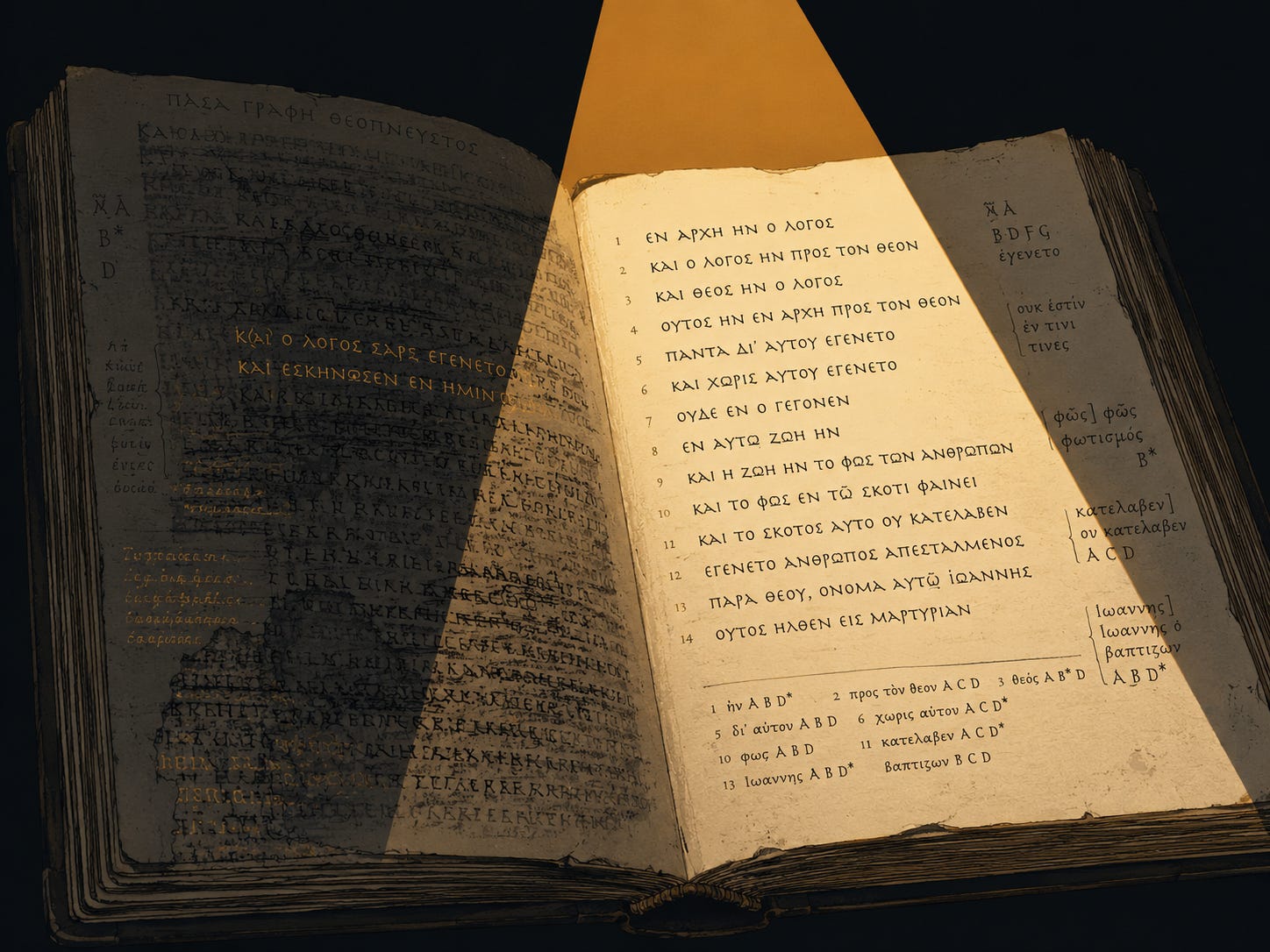
There is a built-in defense mechanism for all of this. Evangelical theology has long taught the doctrine of illumination: the belief that the Holy Spirit grants the faithful reader a special capacity to understand Scripture that is unavailable to the unbeliever or the unbelieving scholar. The proof text is 1 Corinthians 2:14, which states that “the natural person does not accept the things of the Spirit of God, for they are foolishness to him, and he is not able to understand them because they are spiritually discerned.” The application follows without much effort. If you find historical-critical scholarship compelling, or if you find real problems in the text, that isn’t evidence of a problem in the text. It’s evidence you haven’t been illuminated.
This is an epistemologically efficient maneuver, one that doesn’t engage the arguments so much as classify the people making them. The biblical scholar who has spent a career learning ancient languages, studying manuscript traditions, and reading these documents in their historical contexts is, by definition, disqualified from understanding what they mean. The Sunday school teacher with a King James Bible and a strong sense of the Spirit’s guidance is, by definition, authoritative. No amount of evidence changes this calculus, because the doctrine has already determined who counts as a reliable reader.
Odds & Enns - A Substack by Pete Enns, who taught at Westminster Theological Seminary before his views on Scripture’s human character led to his departure, has written at length on how this structure functions and why it eventually fails.2 For Enns, the tradition’s core problem is that it has decided Scripture cannot be allowed to be human in any way that generates complications. The incarnational model he proposes locates Scripture’s humanity as the starting point for honest reading, fully human and fully divine in the same way Christ is.
The complications that honest reading generates are real, and the avoidance of them is structural. The coherence of the evangelical theological package depends, in significant part, on not looking too carefully at the foundations. Inerrancy requires that there be no genuine contradictions in Scripture. Illumination provides a preemptive disqualification for anyone who finds them. The doctrines work together to produce a self-sealing system, and the devotional hermeneutic is the daily practice that keeps it intact.
John Barton’s A History of the Bible makes the point that the Bible we have is the product of specific historical decisions made by specific communities across several centuries.3 Books were included and excluded through processes that were sometimes theological and sometimes frankly institutional. The text underwent transmission through scribal communities who introduced changes, some accidental, some apparently deliberate. For Barton, honest engagement with Scripture begins with confronting what the text actually is, a human library produced by specific people responding to specific pressures.
Dale Martin, whose introductory New Testament course at Yale drew substantial audiences, argues in Biblical Truths that there is no neutral reading of Scripture.4 Every reading community has its own Bible, meaning the canonical decisions, translation choices, and interpretive traditions that determine what the text is taken to mean are always already operating before a word is read. The evangelical Bible is one interpretive tradition among many. Treating it as the default, as though it simply delivers what Scripture plainly says, is itself an interpretive choice, one that the devotional hermeneutic renders invisible.
This is what historical criticism finds when it looks. Genesis 1 and Genesis 2 are two distinct creation accounts from two distinct ancient sources, and they don’t agree with each other in every detail. The Temple cleansing happens at the end of Jesus’s ministry in the Synoptic Gospels and near the beginning in John. Paul almost certainly did not write Ephesians or the pastoral epistles, though both have been read as Pauline for two millennia and carry significant theological weight on that assumption.5 The book of Daniel presents itself as sixth-century prophecy and was almost certainly composed in the second century BCE, during the Maccabean crisis it appears to predict. Every one of these represents the consensus of mainstream biblical scholarship across confessional and non-confessional institutions alike, and most people who grew up in evangelical pews have never encountered any of them. Drink Wisely examined the Gospel authorship and transmission questions in much greater depth in “Four Gospels, No Bylines.”
The devotional hermeneutic doesn’t produce bad people or even necessarily bad theology. What it produces is a biblical illiteracy that passes for biblical literacy. People who have read the Bible every day for forty years and can quote it fluently are sometimes the least prepared to discuss what it actually is, because the method has never asked them to engage that question. Formation organized around a text you’ve never seriously examined tends to become formation around the tradition’s own portrait of it.
. . .
Where the two approaches can actually converge is in the work of scholars who refuse to treat the tension as a forced choice. Enns’s incarnational model is one version of this, accepting that Scripture is a thoroughly human document, produced in specific times and places by people with specific assumptions about the world, and then asking what theological witness that humanity carries. Walter Brueggemann reads the Old Testament with full historical rigor and still hears in it a prophetic address to the present. N.T. Wright treats Paul’s letters as historically grounded documents produced for specific communities under specific circumstances and still argues they carry real theological weight for the church today. The move all of them are making is to let the text be what it is before deciding what it means. That’s more demanding than devotional reading and harder to resolve than purely descriptive scholarship, and the tension it generates doesn’t collapse into a clean synthesis. Probably it isn’t supposed to.
These arrangements protect a particular account of faith that depends on its followers not examining the foundations too carefully. The doctrine of illumination promises the Spirit will guide the faithful reader to the truth of Scripture. In practice, it may be shielding a managed reading from the complications that honest inquiry would introduce. That’s one kind of illumination, I suppose. The doctrine was promising another.
ENDNOTES
1 Bart Ehrman, Misquoting Jesus: The Story Behind Who Changed the Bible and Why (San Francisco: HarperSanFrancisco, 2005). Ehrman estimates more than 200,000 textual variants across the New Testament manuscript tradition. The longer ending of Mark (16:9–20) and the Pericope Adulterae (John 7:53–8:11) are among the most significant passages absent from the earliest manuscripts and almost certainly not original to their respective documents.
2 Peter Enns, Inspiration and Incarnation: Evangelicals and the Problem of the Old Testament (Grand Rapids: Baker Academic, 2005). Enns was suspended and subsequently resigned from Westminster Theological Seminary in 2008 following controversy over this volume, a sequence that illustrates precisely the institutional dynamic the book examines.
3 John Barton, A History of the Bible: The Story of the World’s Most Influential Book (London: Penguin, 2020).
4 Dale B. Martin, Biblical Truths: The Meaning of Scripture in the Twenty-First Century (New Haven: Yale University Press, 2017).
5 Bart Ehrman, Forged: Writing in the Name of God — Why the Bible’s Authors Are Not Who We Think They Are (San Francisco: HarperOne, 2011). Ehrman identifies six letters attributed to Paul as almost certainly pseudonymous, including Ephesians and the three pastoral epistles (1 Timothy, 2 Timothy, and Titus).
What bothers me too much is that the church is worried that people will stop believing if it isn’t “true.” But then again, Bart Ehrman. And many others have become theologians without faith. If we present the scriptures the way you suggest, how do the clergy lead Christian’s to maintain their faith. Is it true that admitting we should look at the texts as human first will collapse our faith and then the collapse of the church will follow? It begins to look like our faith is built on sinking sand. And yet, I know all these things you write about to be true, and although tattered, my faith remains.
Robert Eisenman, in James the Brother of Jesus, notes that in Acts there is an error of fact in Steven's speech just before he is martyred. The error is Steven's statement that Abraham bought the land where Joseph's tomb is.
Upon reading this, everyone in Palestine would say, "Wait a minute, that's Jacob!"
I know some people would say this is Steven's mistake. But Steven was in Palestine, where everyone knows about Joseph's tomb. This sort of mistake is unlikely. Eisenman claims the speech comes from the book of Joshua. The point is that this is in the received text. Lots of people copied it, even though it is easily corrected by reading Joshua. Why wasn't this corrected?
The story of Steven's martyrdom introduces Paul. The received text of Acts ends with the story of Paul. Perhaps the original version of Acts ended with the martyrdom of Jacob (James in English). Thus the error may have been introduced by the second century priest assigned to rewrite Acts to promote Paul and demote Jacob. A priest who knew he was lying, and left a clue for those who knew. Or maybe he thought it was his defense on Judgement Day.