


Julian of Eclanum handed Augustine a sentence from John Chrysostom, and Augustine spent several pages explaining why the sentence did not really mean what it said.
The sentence came from Chrysostom’s homily to the newly baptized. The church baptizes infants, he wrote, though they are not defiled with sin, so that they might receive holiness, righteousness, adoption, and inheritance.1 Julian, who was bishop of Eclanum and one of eighteen Italian bishops who had refused to sign Rome’s condemnation of Pelagius, pointed to the line as evidence that the doctrine Augustine was defending held no standing in the wider church. The bishop of Constantinople had baptized infants for years without believing they carried anyone’s guilt.
Augustine answered Julian in six books. The aptly-titled Against Julian marches through Cyprian, Ambrose, Irenaeus, Basil, Gregory of Nazianzus, and Chrysostom, gathering testimony to show that the doctrine of original sin belonged to the whole church and that Julian was the outlier. When he reaches the Chrysostom passage, he turns to the Greek, points out where the Latin translation has been loosened, and produces a reading in which Chrysostom means only that infants have committed no personal sins of their own.2 Curious.
You see, neither man was reading Greek. Both worked from Latin versions of the homily, and the versions were not even the same one. Antoine Wenger showed that Augustine’s appeal to the Greek text was itself conducted from a revised Latin translation.3 Two Latin-speaking bishops in North Africa and Italy argued over what a Greek bishop in Constantinople had meant, in a language neither of them had open on the desk.
That argument settled the question for the Western church, though, and the West has been living with that decision ever since.
. . .
What the words cover
Four major traditions use the phrase original sin, or its close cousin, and they mean four different things by it.
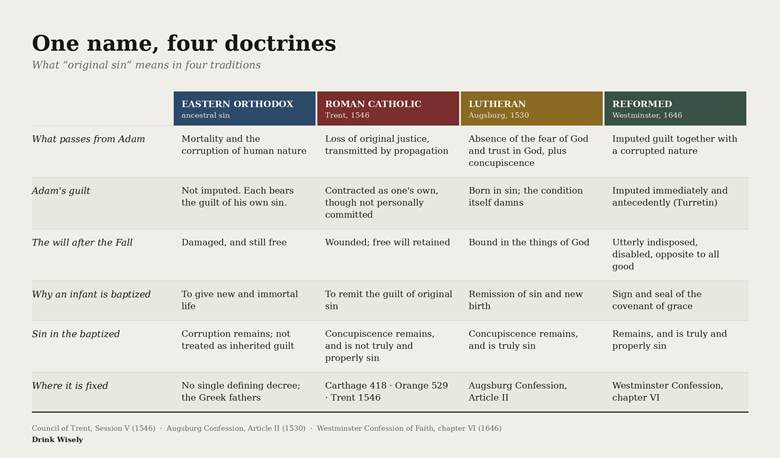
Read the fifth row across in the graphic I have provided. Interestingly, Trent and Westminster utilize nearly identical vocabulary yet land in opposite places. Read the second row and the distance between Constantinople and Geneva turns into a question of jurisprudence. Orthodoxy holds a person answerable only for what he himself has done. Westminster holds that the verdict is entered against him at birth, on the basis of an act committed by someone else.
Anyone who calls the doctrine clear and non-negotiable is defending one of these four positions with much more vigor than the evidence allows.
. . .
Before it had a name
The second and third centuries produced no shortage of pessimism about the human condition. Irenaeus, writing against the Gnostics around 180, describes Adam and Eve as children, made immature by design, and given a command they lacked the maturity to keep.4 Theophilus of Antioch says the same thing more bluntly, that Adam was an infant in understanding and could not yet receive knowledge properly.5 Athanasius, a century and a half later, describes humanity sliding back toward the nothing it was made from, held there by corruption and death, until the Word takes on a body to stop the slide.6 Gregory of Nyssa reads the garments of skin in Genesis 3 as mortality itself, a covering God grants so that the damage will not be permanent.7
None of these men thinks humanity is a-okay. They describe a species that is sick, immature, dying, and unable to fix itself, and every one of them thinks the situation requires God to somehow intervene in person. What none of them describes, notably, is a verdict. The disease travels but the sentence itself does not.
This distinction sounds academic and even trivial until you apply it to a specific infant, which is exactly what Chrysostom does when he baptizes one and says the child carries no sin.
. . .
Four key words in Latin
Romans 5:12 in the NRSVue reads that sin came into the world through one man, and death through sin, and death spread to all because all have sinned.8 The Greek behind that last clause is eph’ hō pantes hēmarton. The prepositional phrase eph’ hō has been read as causal, consecutive, relative, and several other ways; Fitzmyer catalogued nearly a dozen proposals and defended the causal one, which is what most modern translations carry.9 Read causally, the clause says that all sinned, and that death reaches each person on account of that person's own sinning.
The Old Latin rendered those two words in quo (In whom). Death spread to all men, in whom all sinned. The antecedent becomes Adam, and the sentence now says that every human being sinned in Adam, personally and retroactively, at the moment of the first transgression. This is no small difference, to put it lightly.
Augustine took the reading from a Latin commentary on Paul that circulated under the name of Hilary, which we now attribute to an anonymous fourth-century Roman writer scholars call Ambrosiaster.10 His Greek was rather thin and he readily admitted it. The verse he built on was one he could not check in the original.
Drink Wisely has examined elsewhere what happened when Luther took a Latin word and made a whole doctrine out of it. This is an even older instance, and as it turns out to be the more consequential one. David Bentley Hart, an Orthodox scholar who has spent years defending Augustine on other fronts, calls it the most disastrous misreading in the history of Christian exegesis.11
. . .
Augustine, given his due
This questionable preposition did not invent the doctrine of original sin on its own, and any account that says it did wouldn’t survive five minutes with someone who has read much at all in his Anti-Pelagian writings.
Augustine inherited a church that already baptized infants and already described that baptism as remission of sin. Cyprian’s council of sixty-four African bishops had ruled in the 250s that infants should be baptized before the eighth day, and Cyprian’s reasoning comes remarkably close to Augustine’s, that the newborn has committed no sin of his own except that, born of the flesh after Adam, he has contracted the contagion of the ancient death.12
Ambrose said adjacent things in Milan. The liturgy of Augustine’s own church included exorcism and exsufflation in the rite for infants, and Augustine treated that practice as proof of the doctrine, adding that the church hisses at the child only to drive out the one whose sway the child was born under.13
The Latin Bible translation reinforced all of this, of course. Psalm 51:5 came to Latin readers as a confession of guilt from the womb. Job 14:4 in the Old Latin included a line about no one being clean, not even the infant whose life on earth has lasted a single day. Ephesians 2:3 called the human race natura filii irae, children of wrath by nature.14 Reading those verses in Latin, in a church that exorcised babies, a man who had spent his youth cataloguing the disorder of his own desires would read in quo as confirmation of what he already believed.
So the honest version of the charge is narrower and significantly harder to dismiss. The Latin mistranslation did not create the intuition; that already existed. It gave the intuition a mechanism, and the mechanism let a pastoral instinct harden into a full-blown metaphysics of transmitted guilt that the church would then be required to defend henceforth.
Julian recognized the shortcomings of this approach immediately, it seems. Guilt requires a will. An act I did not perform, could not have prevented, and was not present for cannot be charged to my account, and simply calling the charge inherited does not solve the problem either, since inheritance transfers property and guilt is not property. Augustine’s answers run through the mechanics of generation, the disorder of sexual desire, and the claim that all humanity was seminally present in Adam and therefore really did act in him. Each answer, however, merely relocates the difficulty. None of them resolves it. So, sixteen centuries later the Reformed tradition would stop trying to address it and simply legislate the result.
. . .

What it cost him
Julian pressed the point precisely where it hurt. If infants inherit guilt, and baptism remits guilt, then an infant who dies unbaptized is condemned, and the God who arranged this is a God who damns babies for a crime committed by a man in a garden.
Still, Augustine didn’t flinch and didn’t equivocate on his position. In De peccatorum meritis he holds that such infants suffer eternal condemnation, though he adds that theirs is the mildest condemnation of all.15 The Enchiridion uses the same formula, the mildest punishment.16 When the Pelagians proposed a middle destination, a place of rest and happiness outside the kingdom, Augustine rejected it explicitly as their invention and insisted there is no third place.17 Writing to Jerome, he said that anyone who claims such children will be made alive in Christ contradicts the apostle and condemns the whole church.18
Note what the qualifier does and does not do here. Augustine reduced the temperature slightly by postulating some kind of ease of torment’s severity, but he never touched the eternality of the damnation.
Everything the Western church has said on this question since that time has been largely an effort to escape a verdict it will not flat-out repudiate.
. . .
Rome applies the brakes
Trent took up original sin at its fifth session, in June 1546, and produced five decrees that are more nuanced than most Protestants assume.
The first four read as one might expect. Adam lost holiness and justice for himself and for all his descendants, transmitted that loss by propagation, and the loss is in each person as his own. Infants are baptized for the remission of that sin, and the sin must be expiated by the new birth.
The fifth decree is where Rome pumps the brakes. Baptismal grace remits the guilt of original sin and takes away everything that has the true and proper nature of sin. Concupiscence, the disordered pull of desire toward sin, remains in the baptized, left in place for the struggle, and it cannot injure anyone who refuses consent. Paul calls it sin, according to the council, because it comes from sin and inclines toward sin. Anyone who posits that concupiscence in the regenerate is truly and properly sin falls under anathema.19
Session VI added the other brake. Anyone who says free will was extinguished by Adam’s fall also falls under anathema. Trent’s language has the will very much weakened and bent, but still standing.20
Modern Catholic teaching sharpens the same distinction. Original sin is contracted, not committed. It describes a condition, and in Adam’s descendants it does not carry the character of personal fault.21 A Catholic infant is born into a deprivation, and baptism ends that deprivation completely.
Augustine would have recognized the doctrine as such but resented the added qualifications.
. . .
Wittenberg and Geneva release them
Sixteen years before the council of Trent, the Augsburg Confession had already gone the other direction. Everyone born in the natural way is born with sin, meaning without fear of God, without trust in God, and with concupiscence. That disease of origin is truly sin, and it damns and brings eternal death now to anyone not born again through baptism and the Spirit.22 The article closes by condemning those who deny that original depravity is sin.
Trent’s fifth decree is aimed directly at that sentence. Westminster, ninety years later, aims right back at Trent.
The English divines wrote that the guilt of Adam’s sin was imputed to all his posterity, along with the death in sin and the corrupted nature, conveyed by ordinary generation.23 From that corruption, they continue, we are utterly indisposed, disabled, and made opposite to all good, and wholly inclined to all evil.24 That is the clause behind the phrase total depravity, and it goes well past anything Trent would have signed. Then comes the real collision. The corruption remains in those who are regenerated, and though pardoned and mortified through Christ, both the corruption itself and all its motions are truly and properly sin.25
Trent said the phrase and anathematized it. Westminster said the phrase and confessed it. Two councils, ninety years apart, arguing over the same six words and their implications.
Francis Turretin finished the job. Working through the ninth topic of the Institutes, he distinguished immediate and antecedent imputation from mediate and consequent imputation and defended the former. Adam’s actual disobedience is charged to every descendant directly, prior to and independent of any corruption that descendant inherits or any act he commits.26
Julian’s question, then, about how guilt could pass without a will was not answered; it was simply overruled.
The tradition then discovered it couldn’t really hold the line. Josué de la Place, teaching at Saumur, proposed that we derive a corrupt nature from Adam and that the corrupt nature is what grounds our condemnation, which preserved the doctrine while removing the legal fiction at its center. The national synod at Charenton condemned that position in 1645 without naming him. He answered a decade later with a distinction between mediate and immediate imputation, and Turretin dismissed the distinction as a smokescreen raised to evade a censure the man knew was aimed at him.27
A Reformed professor tried to make the doctrine coherent and spent the rest of his career explaining that he had done no such thing.
Note the significance of the chronology here. Augsburg was 1530. Westminster was 1646. Turretin published between 1679 and 1685. The most severe version of the doctrine of original sin in the Christian world is, coincidentally, also the most recent.
. . .
The exemption department
A doctrine this total (pun intended) produces problems its adherents cannot handle, and the Western church has spent the better part of two millennia building in relief valves to ease the pressure.
The first one is Mary, and Augustine builds this one himself. In De natura et gratia he sets her aside from the discussion of sin out of honor for the Lord and says he would rather not pursue the question.28 So, the man who insisted that no one escapes the condemned mass made an exception before anyone even asked him for one. That certainly didn’t take long.
Turning that instinct into formal doctrine, however, took five centuries and a brand-spanking-new theory of redemption. Bernard objected. So did Alexander of Hales, Bonaventure, and Aquinas, all on the same ground, that a Mary who never contracted original sin is a Mary who did not need Christ to redeem her in the first place.29 Duns Scotus broke the deadlock by arguing that preservation is somehow a superior form of redemption, since Mary was kept from contracting what she otherwise would have contracted, which makes her even more indebted to Christ than the rest of us.30 Sixtus IV gave the conclusion papal cover in 1483 by forbidding either party to call the other heretical.31 Trent then wrote the exception into the original sin decree itself, declaring that it did not intend to include Mary and pointing back to Sixtus.32 Pius IX defined the dogma in 1854 and cited Scotus by name.33
Got all that? But wait, there’s more.
The second relief valve is limbo, and it exists because Augustine’s answer on unbaptized infants was intolerable almost immediately. He had ruled out any third destination. The medieval West invented one anyway, as it was wont to do, distinguishing the loss of the vision of God from the pain of sense and assigning infants only the former. Aquinas went even further than that, granting them a natural happiness and no awareness of what they were missing.34 An eternal lobotomy, I suppose. Lyons in 1274 and Florence in 1439 both declared that those who die in original sin alone descend to hell, though with unequal punishments.35
Limbo was never specifically defined as church dogma. In April 2007 the International Theological Commission demoted it to a possible theological hypothesis, and the document is careful about its own standing, noting that the Commission is not an organ of the Magisterium and that its conclusions offer reasons for prayerful hope instead of certainty.36
Five whole centuries of theological engineering produced a binding exemption for one woman. Sixteen centuries produced a non-binding one for dead children and then withdrew it. Neither project, ironically, addressed the very premise that made both necessary.
. . .
The Reformed relief valve, and its defect
Westminster deals with unbaptized infants in only a single clause. Elect infants dying in infancy are regenerated and saved by Christ through the Spirit, who works when and where and how he pleases.37
And the word elect has been under significant debate ever since. B. B. Warfield called the reading that finds non-elect infants implied in the clause one of the most astonishing pieces of misrepresentation in literary history.38 He may be right about the drafters’ intent. He is harder to follow on what happened next, because in 1903 the Presbyterian Church in the U.S.A. adopted a Declaratory Statement announcing that the Confession is not to be regarded as teaching that any who die in infancy are lost, and affirming that all who die in infancy are included in the election of grace.39
Denominations are not typically in the business of issuing clarifications about language that never bothered anyone.
The Evangelical Presbyterian Church, formed in 1981, had to decide which of the Presbyterian revisions it would affirm. Its Ad Interim Committee on Theology brought a Declaratory Statement of its own to the sixth General Assembly in June 1986, covering chapter 3 on the eternal decree and chapter 10 on effectual calling. On infants the proposed text held that chapter 10.3 is not to be regarded as teaching that those who die in infancy are lost, and that the salvation of those dying in infancy is grounded in the sovereign election of God, who saves by Christ through the Spirit.40
The Assembly tabled the statement pending a ruling from the Permanent Judicial Commission, which turned out to lack a quorum. Commissioners then affirmed the Stated Clerk’s ruling that adoption would make the statement a descending overture requiring approval by three-quarters of the presbyteries. A hand count followed, sixty-nine to sixty-three in favor. A recount was then requested. On a standing count, the statement was defeated seventy-two to seventy-one.41
The next day a motion directing the permanent Committee on Theology to take up the issues the debate had raised was not sustained.42
There you have it. I was a ruling elder in that denomination for fourteen years. I was not aware until this year that it had declined, by a single vote, nonetheless, to say that no infant who dies is lost, and then declined to discuss the matter further.
. . .
The best argument on the other side
The strongest case for inherited guilt is a structural one, and anyone raised inside the Reformed world has surely heard it.
Everyone dies, including infants who have done nothing. Universal death implies a universal cause, and Paul locates that cause in Adam. Everyone needs Christ, and if some human beings arrive innocent then the gospel becomes optional for them, which no reading of the New Testament permits. Remove inherited guilt and Adam’s sin becomes an example we copy, which is the position the church condemned at Carthage and again at Ephesus. Romans 5 requires a real solidarity in Adam parallel to the real solidarity in Christ, and solidarity that transmits nothing is only a figure of speech.
The East answers all of this without the imputation apparatus. Death and corruption pass to everyone, which supplies the universal cause. Everyone dies and everyone sins, which supplies the universal need. Athanasius builds an argument for the incarnation entirely out of corruption and death and arrives at a Christology no one has ever called deficient, at least formally. Two thousand years of Greek and Slavic Christianity have run without a doctrine of inherited guilt and have not produced a single Pelagian communion of which I’m aware.
An honest complication exists here that will require more than a footnote to address. The clean contrast between ancestral sin in the East and original sin in the West is, at least partly, a twentieth-century product. John Romanides drew the line sharply and John Meyendorff followed him. Read the Greek fathers directly and they turn out to be less uniform than that account requires, and Jean-Claude Larchet finds language of ancestral guilt in Maximus the Confessor, reading him as standing somewhere between the two conceptions.43
That complication has obvious limits, of course, and those limits are the real proving point. The live dispute is whether the Greek fathers carry some notion of inherited liability. Nobody argues that they carry federal headship, immediate imputation, or a corruption in the baptized that remains truly and properly sin. The disputed ground lies nowhere near Turretin’s construct.
. . .
Read the whole verse
The version of original sin defended most fiercely in American evangelical pulpits is younger than the printing press, harsher than Rome’s, basically unknown in the Christian East, and built directly on two Latin words the original Greek scripture does not contain.
Hart points out that Augustine cites the first half of Romans 5:18 with enthusiasm and the second half with reluctance, though the two halves share a grammar and a conjunction and were written by the same man in the same breath.44 Here is the sentence in its entirety.
Therefore just as one man’s trespass led to condemnation for all, so one man’s act of righteousness leads to justification and life for all.45
Sixteen centuries of Western theology have largely treated the first clause in that sentence as an accurate description of reality and the second clause as just a metaphor.
Notes
1. John Chrysostom, Homily to the Neophytes, quoted in Augustine, Against Julian 1.6.21. The passage survives in this form largely through Augustine’s citation of it.
2. Augustine, Against Julian 1.6.21 (PL 44, 654–58).
3. Antoine Wenger, ed., Huit catéchèses baptismales inédites, Sources Chrétiennes 50 bis (Paris, 1970). Both Julian and Augustine worked from Latin versions of the homily, and the versions differed.
4. Irenaeus, Against Heresies 4.38.1.
5. Theophilus of Antioch, To Autolycus 2.25.
6. Athanasius, On the Incarnation 4–5.
7. Gregory of Nyssa, Catechetical Oration 8.
8. Romans 5:12, NRSVue.
9. Joseph A. Fitzmyer, Romans, Anchor Bible 33 (New York: Doubleday, 1993), 413–17.
10. Augustine cites the commentary on Romans 5:12 as the work of Sanctus Hilarius in Contra duas epistulas Pelagianorum 4.4.7 (CSEL 60:528). Erasmus questioned the traditional attribution to Ambrose in 1527, and Alexander Souter, A Study of Ambrosiaster, Texts and Studies 7.4 (Cambridge, 1905), established the modern consensus.
11. David Bentley Hart, “Traditio Deformis,” First Things, May 2015.
12. Cyprian, Letter 64 (to Fidus).
13. Augustine, De symbolo ad catechumenos 1.2 (CCL 46:186); Against Julian 6; De nuptiis et concupiscentia 1.26. See William Harmless, Augustine and the Catechumenate (Collegeville: Liturgical Press, 1995), 261–65, and Harmless, “Christ the Pediatrician: Infant Baptism and Christological Imagery in the Pelagian Controversy,” Augustinian Studies 28 (1997): 7–34.
14. Psalm 51:5; Job 14:4–5 in the Old Latin, echoed at Augustine, Confessions 1.7.11; Ephesians 2:3. The Hebrew of Psalm 51:5 is a poetic self-accusation about the psalmist’s own condition and does not carry the doctrinal weight the Latin tradition placed on it.
15. Augustine, De peccatorum meritis et remissione 1.16.21.
16. Augustine, Enchiridion 93.
17. Augustine, De anima et eius origine 1.9.11; 2.12.17. For the Pelagian position Augustine is rejecting, see De haeresibus 88.
18. Augustine, Letter 166, to Jerome.
19. Council of Trent, Session V, Decree Concerning Original Sin (17 June 1546), especially the fifth decree.
20. Council of Trent, Session VI, Canon 5.
21. Catechism of the Catholic Church, §§404–5.
22. Augsburg Confession, Article II (1530); see also Melanchthon’s expansion in the Apology, Article II.
23. Westminster Confession of Faith VI.3.
24. Westminster Confession of Faith VI.4.
25. Westminster Confession of Faith VI.5.
26. Francis Turretin, Institutes of Elenctic Theology, Ninth Topic, Question 9.
27. The National Synod of Charenton condemned the denial of the imputation of Adam’s sin in 1645 without naming Placaeus, who published his Disputatio de imputatione primi peccati Adami in 1655. On the charge that the mediate/immediate distinction was a device to evade censure, see Turretin, Institutes, Ninth Topic, Question 9, and R. L. Dabney’s later restatement of the same accusation. The synod sat from December 1644 into 1645, and sources give both years.
28. Augustine, De natura et gratia 36.42.
29. Thomas Aquinas, Summa Theologiae III, q. 27, a. 2.
30. John Duns Scotus, Ordinatio III, d. 3, q. 1.
31. Sixtus IV, Cum praeexcelsa (1477) and Grave nimis (1483).
32. Council of Trent, Session V, closing clause of the Decree Concerning Original Sin.
33. Pius IX, Ineffabilis Deus (8 December 1854).
34. Thomas Aquinas, De Malo, q. 5, a. 3.
35. Second Council of Lyons (1274); Council of Florence, Laetentur caeli (1439).
36. International Theological Commission, The Hope of Salvation for Infants Who Die Without Being Baptized (19–20 April 2007).
37. Westminster Confession of Faith X.3.
38. B. B. Warfield, “The Development of the Doctrine of Infant Salvation” (1891).
39. Presbyterian Church in the U.S.A., Declaratory Statement (1903).
40. Minutes of the 6th General Assembly, Evangelical Presbyterian Church (Livonia, MI, 16–19 June 1986), §6-25, which reproduces the proposed Declaratory Statement in full.
41. Minutes of the 6th General Assembly, §6-26 (the Stated Clerk’s ruling on descending-overture status) and §6-27 (the two votes).
42. Minutes of the 6th General Assembly, §6-34.
43. On the exegesis of Romans 5:12 among the Greek fathers, see David Weaver, “From Paul to Augustine: Romans 5:12 in Early Christian Exegesis,” St Vladimir’s Theological Quarterly 27.3 (1983), continued in SVTQ 29.2 and 29.3 (1985). For ancestral guilt in Maximus, Jean-Claude Larchet, “Ancestral Guilt According to St. Maximus the Confessor,” Sobornost 20 (1998). The sharp form of the distinction derives from John Romanides, The Ancestral Sin, trans. George S. Gabriel (Ridgewood: Zephyr, 2002), and John Meyendorff, Byzantine Theology (New York: Fordham University Press, 1976), 143ff.
44. David Bentley Hart, “Traditio Deformis,” First Things, May 2015.
45. Romans 5:18, NRSVue.
Love this discussion! As an old lay person with decades of study in the Bible and Christian History, I have come to the conclusion that one’s belief is almost entirely based on which viewpoint they choose to accept.
Most people simply parrot what they have been taught accepting it as universal and often defend their accepted position as absolute truth.
My studies over the decades have lead me to question almost everything I was taught, believed, and promoted for the first 27 years of my life. It was in a well-known, conservative, Evangelical seminary that I suddenly realized that the lesson I was taking notes on was entirely built upon highly questionable assumptions and beliefs.
50 years later, as a liberal Episcopalian, I only confidently believe that a loving God exists and that I choose to honor God by living in that flawed Christian tradition. I strive to live out the moral teachings of Jesus with the realization that his unfulfilled apocalyptic views influenced his most extreme teachings. For me, the rest of Christianity is mired in historical theology which I hold tenuously and lightly.
I recite the ancient creeds despite gaping questions and doubts. I sincerely honor the Eucharist because of the presence of Jesus I feel in it. I kneel, I stand, I genuflect, I bow out of gratitude to God’s continued love. I find comfort in the litany even as I must sometimes treat with ambiguity for the implied, erroneous theology.
To many Evangelicals, I no longer qualify as Christian.
I'm sorry but I don't exactly understand. In old Latin, "the sentence now says that every human being sinned in Adam, personally and retroactively, at the moment of the first transgression." But what exactly does the Greek original say? I can't make that out from what you've written. Sorry.